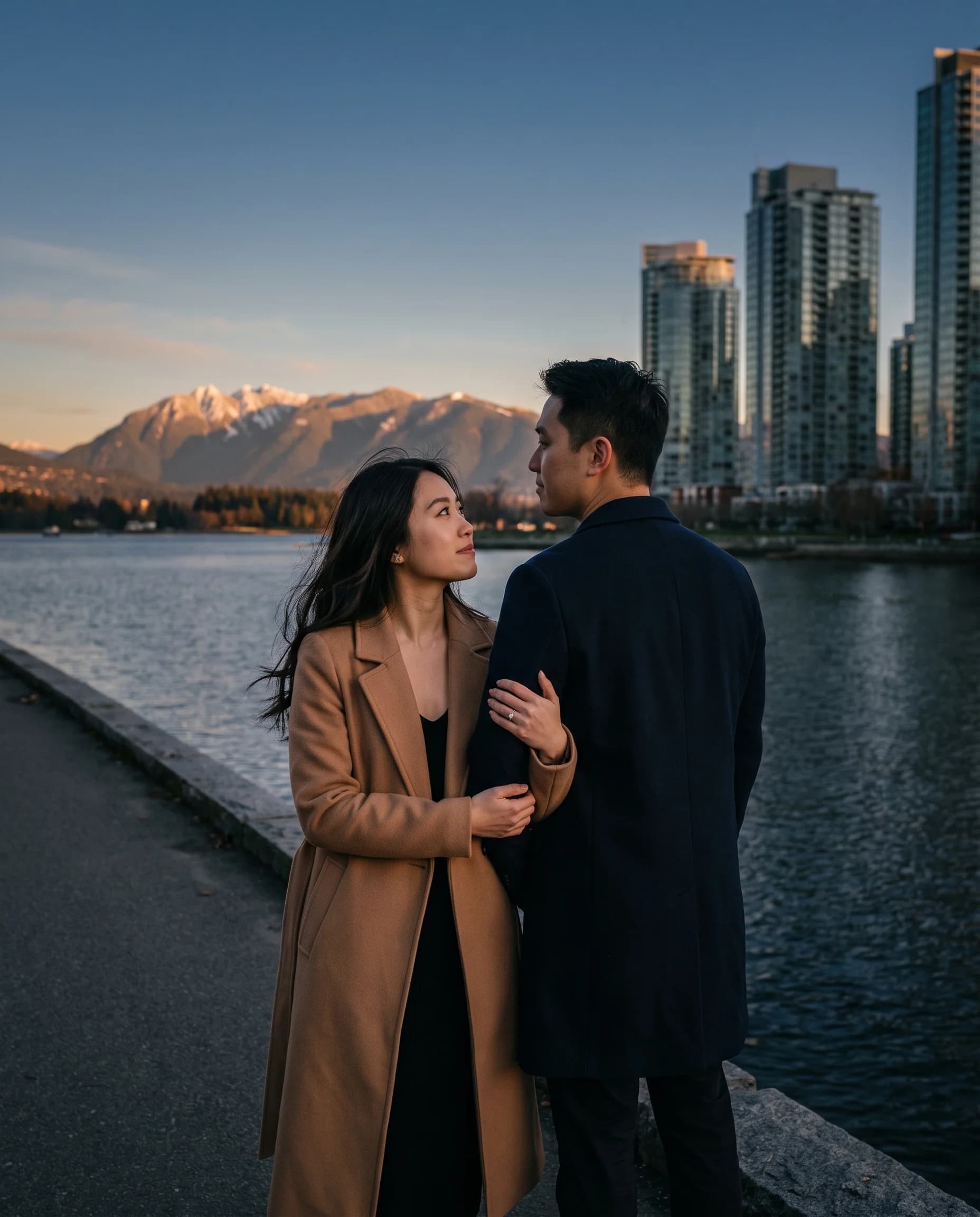
An engagement session is the one shoot where you get to choose the location properly, because it is the only one with nothing else attached to it. No guests are driving to it. No caterer is holding dinner. Nobody is standing in a dress they cannot sit down in. If the forecast is wrong on Thursday you move it to Sunday, and the only two people inconvenienced are the two people in the photographs.
An engagement session is not a scaled-down wedding day
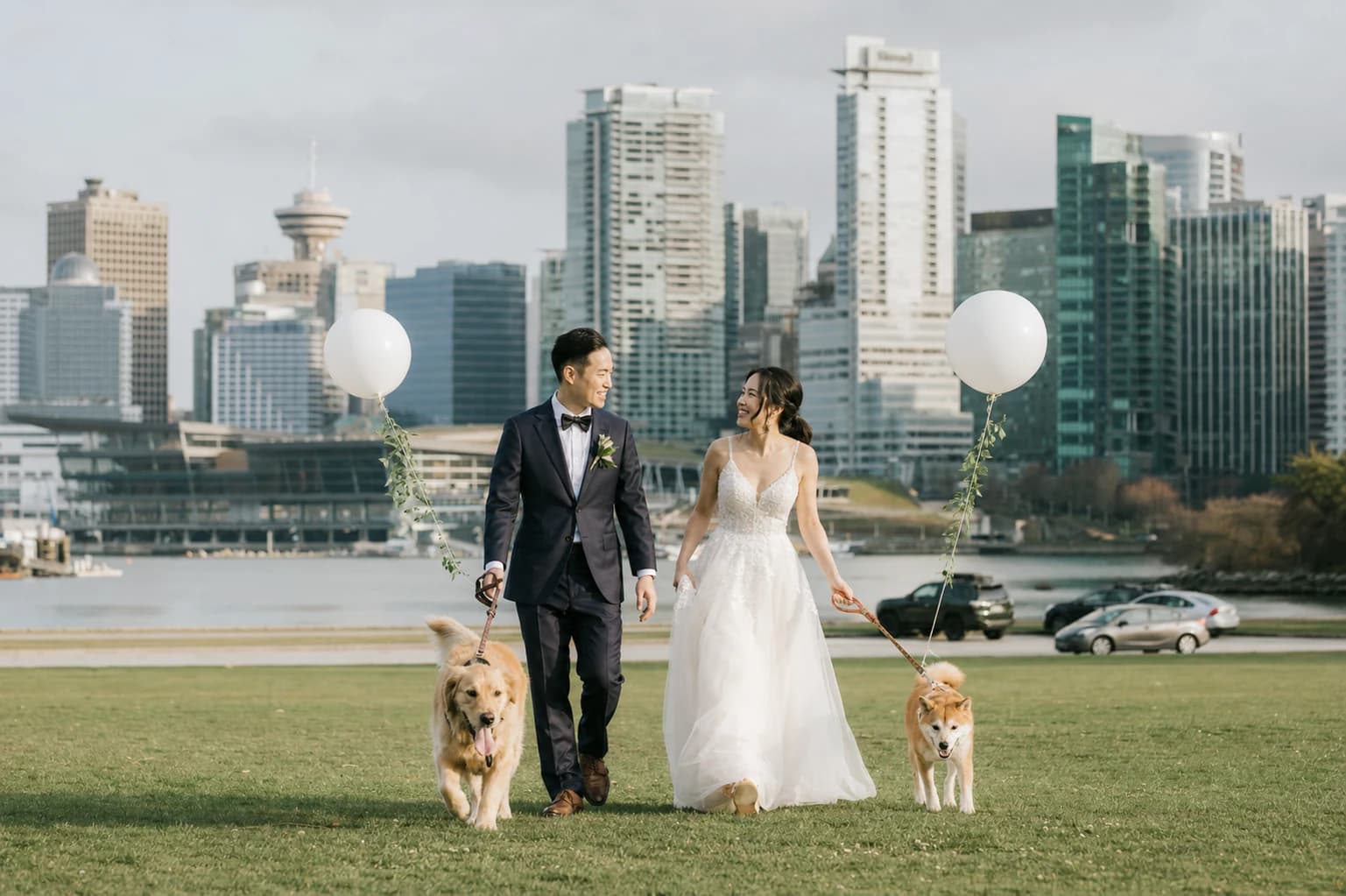
Couples usually treat the engagement session as a rehearsal and pick somewhere near the venue. That is the wrong instinct, because it imports every constraint of the wedding day into the one shoot that does not have them.
The engagement session can move. That single fact is worth more than any location on this list. It means you can book a weekday at the end of October, watch the forecast for four days, and go on the grey damp morning that makes a rainforest look the way a rainforest is supposed to look. It means sunrise is available, which it almost never is on a wedding day. It means an hour of driving each way is a reasonable thing to spend.
So the sorting question is not "where is convenient". It is "what month is it, and what does that month do well here". Vancouver has a genuinely short season for fields and flowers, a long and reliable season for forest and rain, and a narrow window at altitude where there is snow but the road is still pleasant. Pick the place that matches the month and this city is very hard to beat. Pick the place you saw on a feed in July and shoot it in January and you will wonder why it looks nothing like the picture.
Golden Ears Provincial Park, for scale without a hike
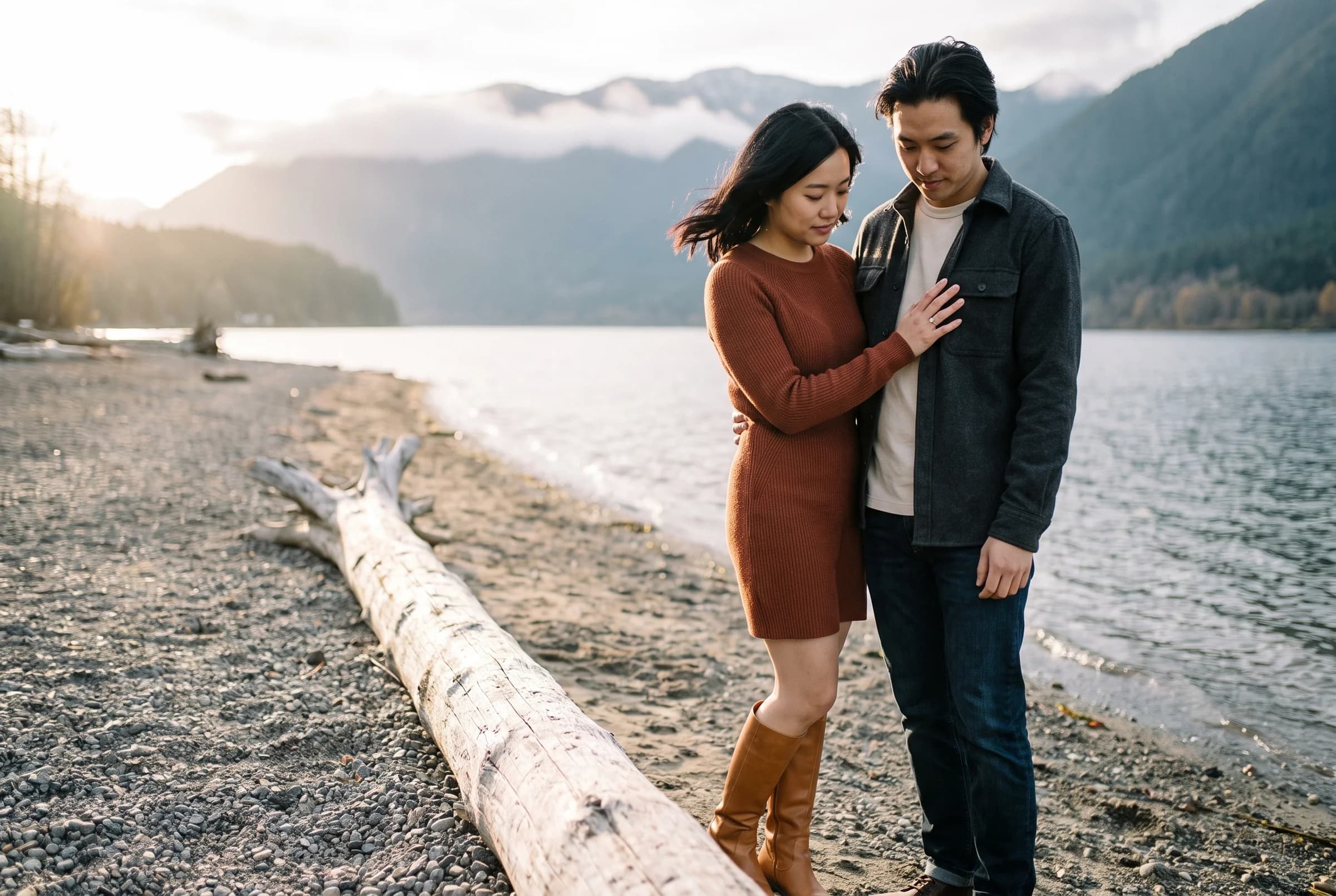
Alouette Lake gives you the thing most couples are actually asking for when they say they want mountains: steep forested walls on both sides, a long sheet of water, and a gravel shore full of bleached driftwood you can put in the foreground. You get all of it a short walk from a parking lot, with no elevation gained.
The constraint is the day-use pass. BC Parks requires a free vehicle pass at the signed lots here from Friday to Monday and on holidays between 15 May and 7 September, and it is not required after 3:30pm. That last clause is the useful one: an evening session in summer skips the pass entirely, and evening is when this lake is at its best anyway.
Blackie Spit, for the biggest sky in the Lower Mainland
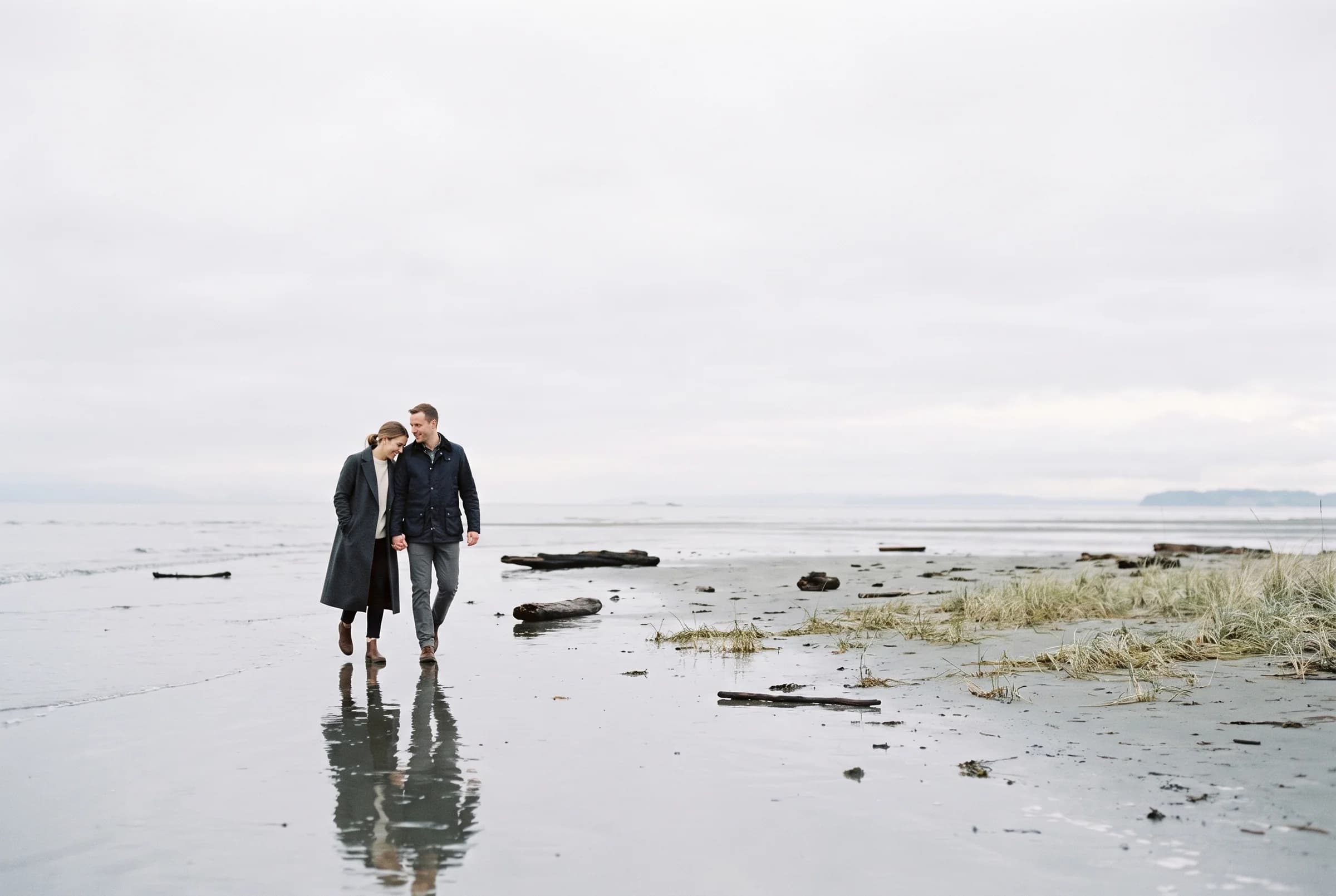
Blackie Spit at Crescent Beach in Surrey is flat, low and open, which in a region full of vertical scenery is exactly why it is useful. The horizon sits low, the sky takes up most of the frame, and at low tide the flats hold a thin sheet of water that reflects the entire sky.
Check the tide table before you set the time, not after. This is the one location here where the tide matters more than the light. At high water it is a pleasant ordinary beach. At low water twenty minutes after sunset it is the best blue hour in the Lower Mainland, and the two states are a few hours apart on the same afternoon.
Stave Lake, for something that looks nothing like a park
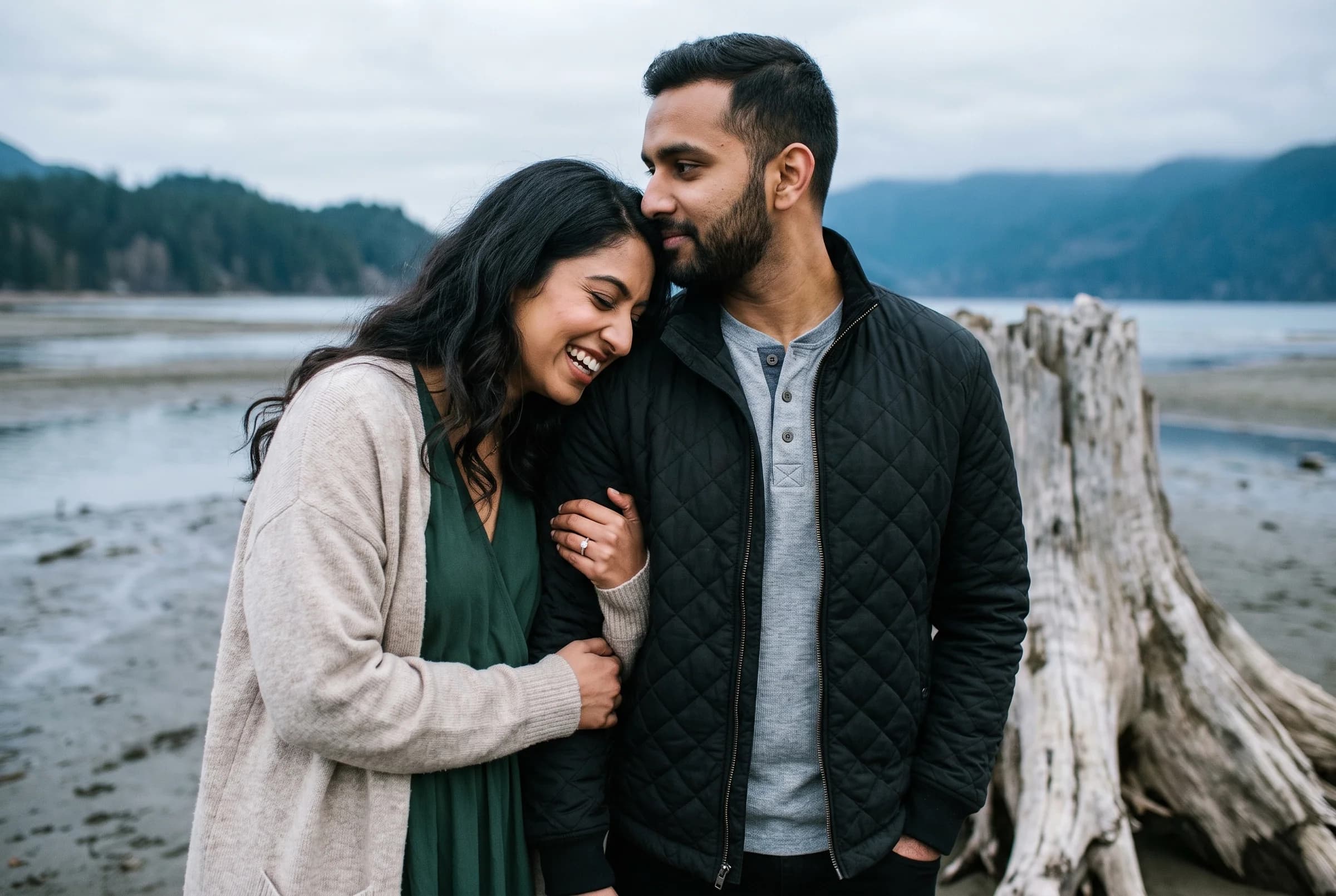
Stave Lake out past Mission is a reservoir, and when the water is drawn down it leaves a wide pale shoreline of silt and gravel with bleached stumps standing in the shallows. It reads as slightly post-apocalyptic and it is the least generic backdrop within reach of the city.
It is not pretty in the ordinary sense and that is the point. Couples who want soft and romantic should go somewhere else on this list. Couples who want a frame nobody else on their feed has should go here on a flat grey day, which is when the stumps and the silt read best.
Cleveland Dam, for the Lions in four minutes
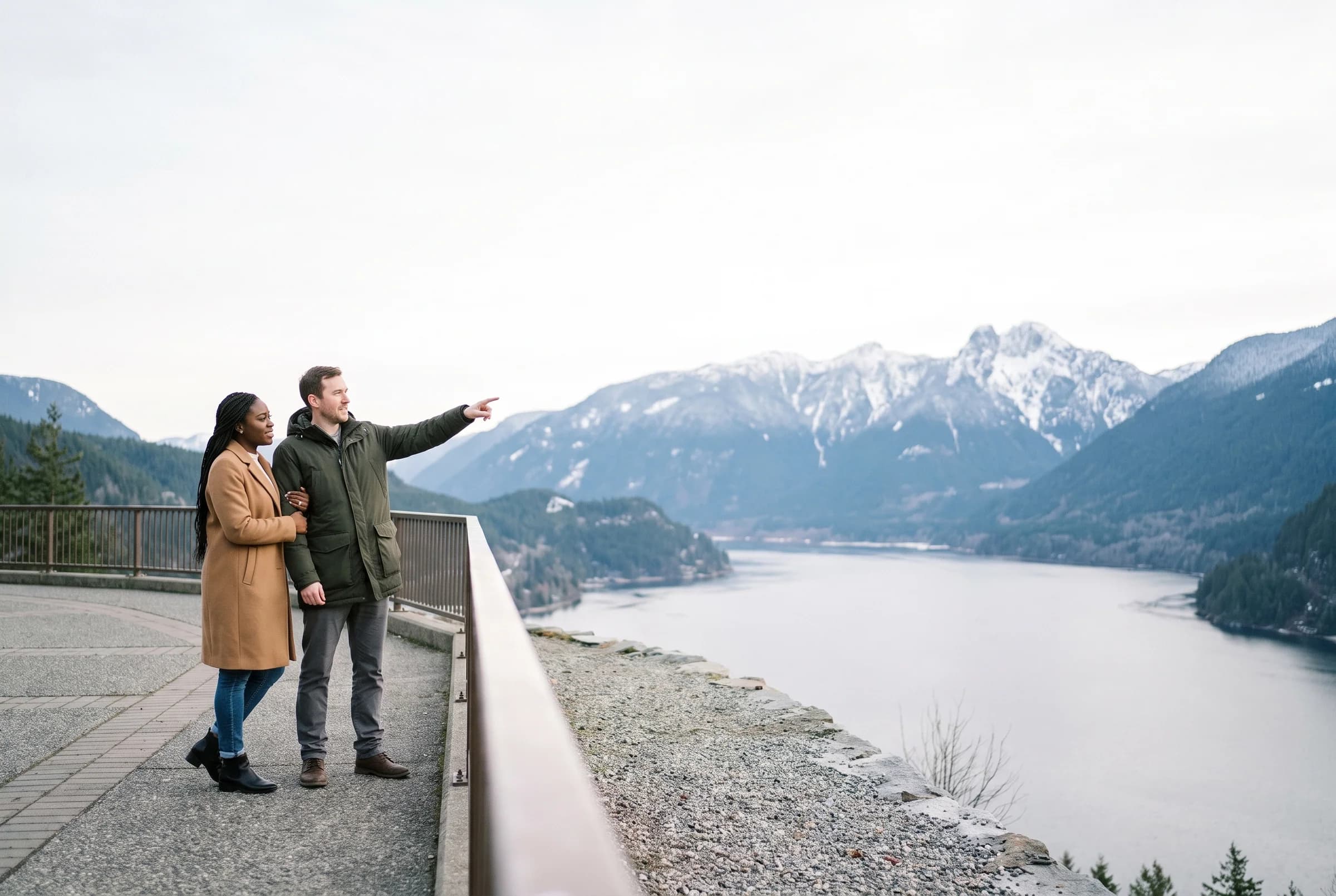
The lookout above Capilano Lake frames the twin peaks of the Lions almost perfectly, and it takes about four minutes from the car. There is no trail, no scramble and no change of shoes, which makes it the best location in the region for anyone with a mobility limit or a low tolerance for effort.
It is also the most weather-dependent place here. The whole value is the view up the valley, and on a low-cloud day there is no view up the valley. This is a location to hold loosely and go to on a clear cold afternoon, which is precisely the kind of decision an engagement session lets you make and a wedding day does not.
Pitt Lake, for mist and reeds at sunrise
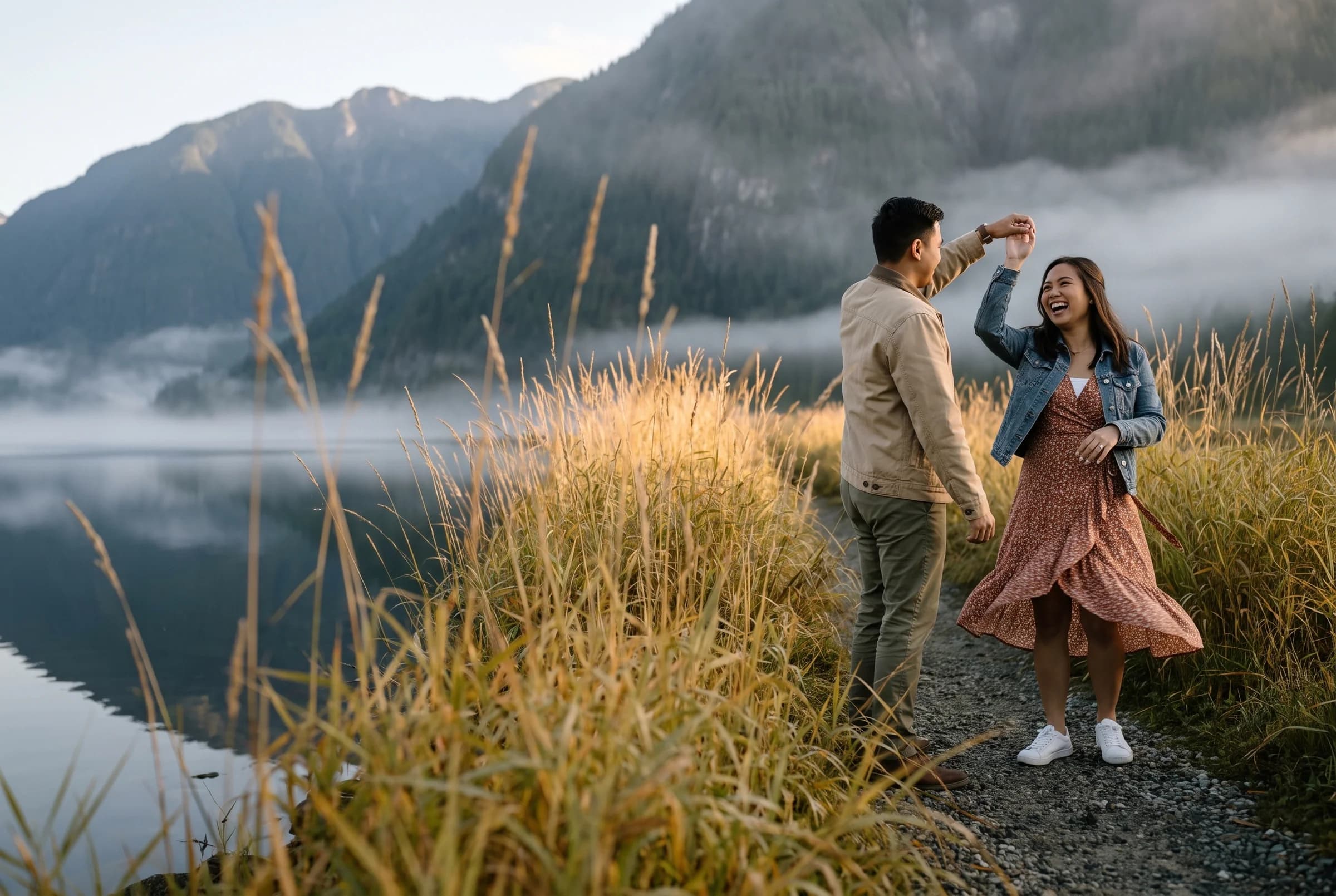
Grant Narrows at the south end of Pitt Lake is a wide flat wetland of tall golden marsh grass with mountains standing straight up out of the water at the far end. In autumn the mist sits on the surface until the sun gets over the ridge, and the dyke paths mean you can walk out into the middle of all that on level ground.
This one is worth getting up for. It is the strongest sunrise location on this list and a fairly ordinary midday one. If you are not willing to meet at first light, choose somewhere else and save yourself the drive.
Lighthouse Park, for granite, arbutus and rain
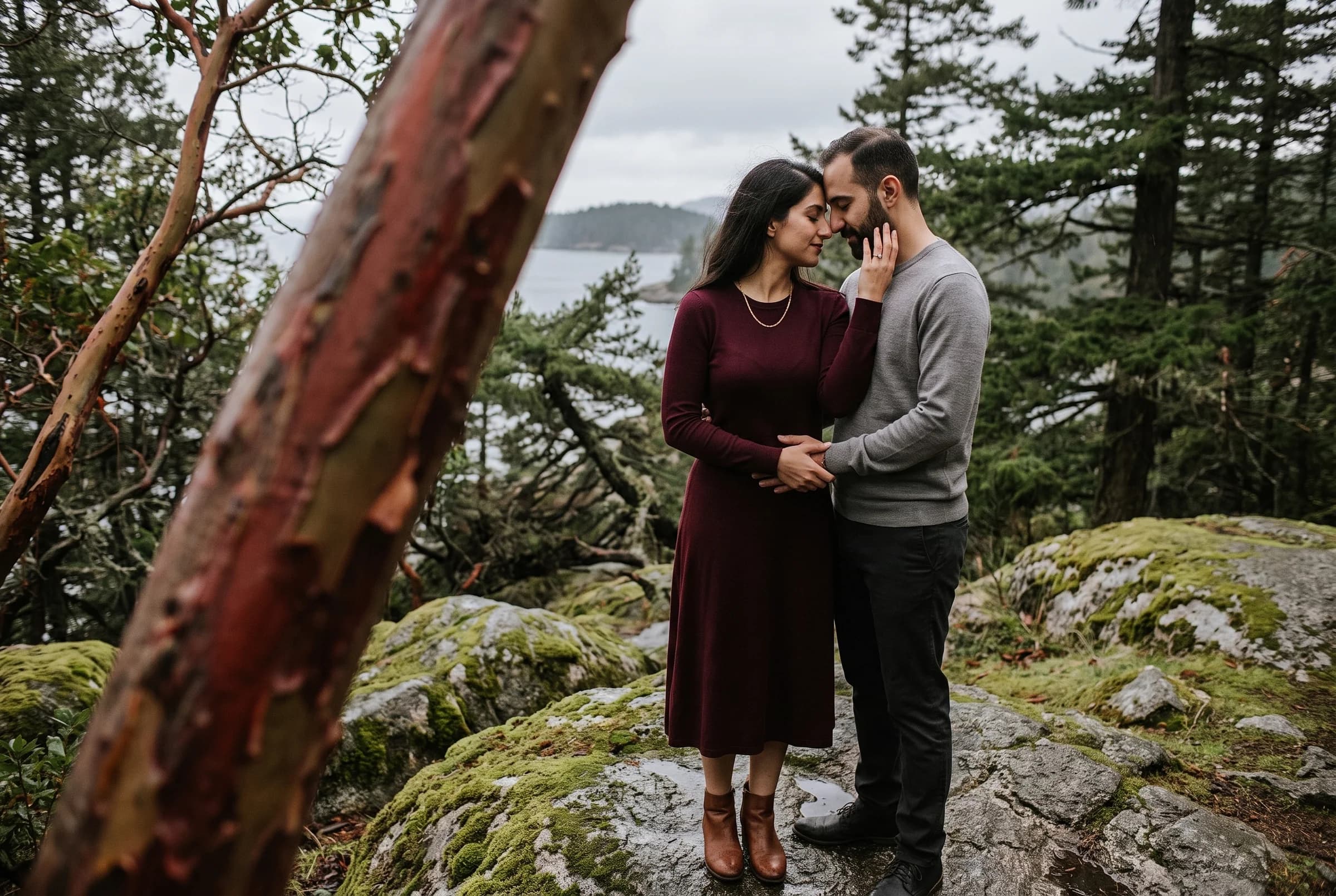
Lighthouse Park in West Vancouver has the best combination of old-growth forest and open granite anywhere near the city, with peeling red arbutus trunks that give you a foreground unlike anything else in the region. The rock runs down into the sea and the trees come almost all the way to it.
It is better in the rain than in the sun, which is a genuinely useful thing to know in a city that is wet for half the year. Wet granite, wet moss and wet arbutus bark all gain colour. The trail to the good rock takes ten to fifteen minutes over roots and a short descent, so wear something you can actually walk in and carry the other shoes.
Vedder River, for open gravel and no people
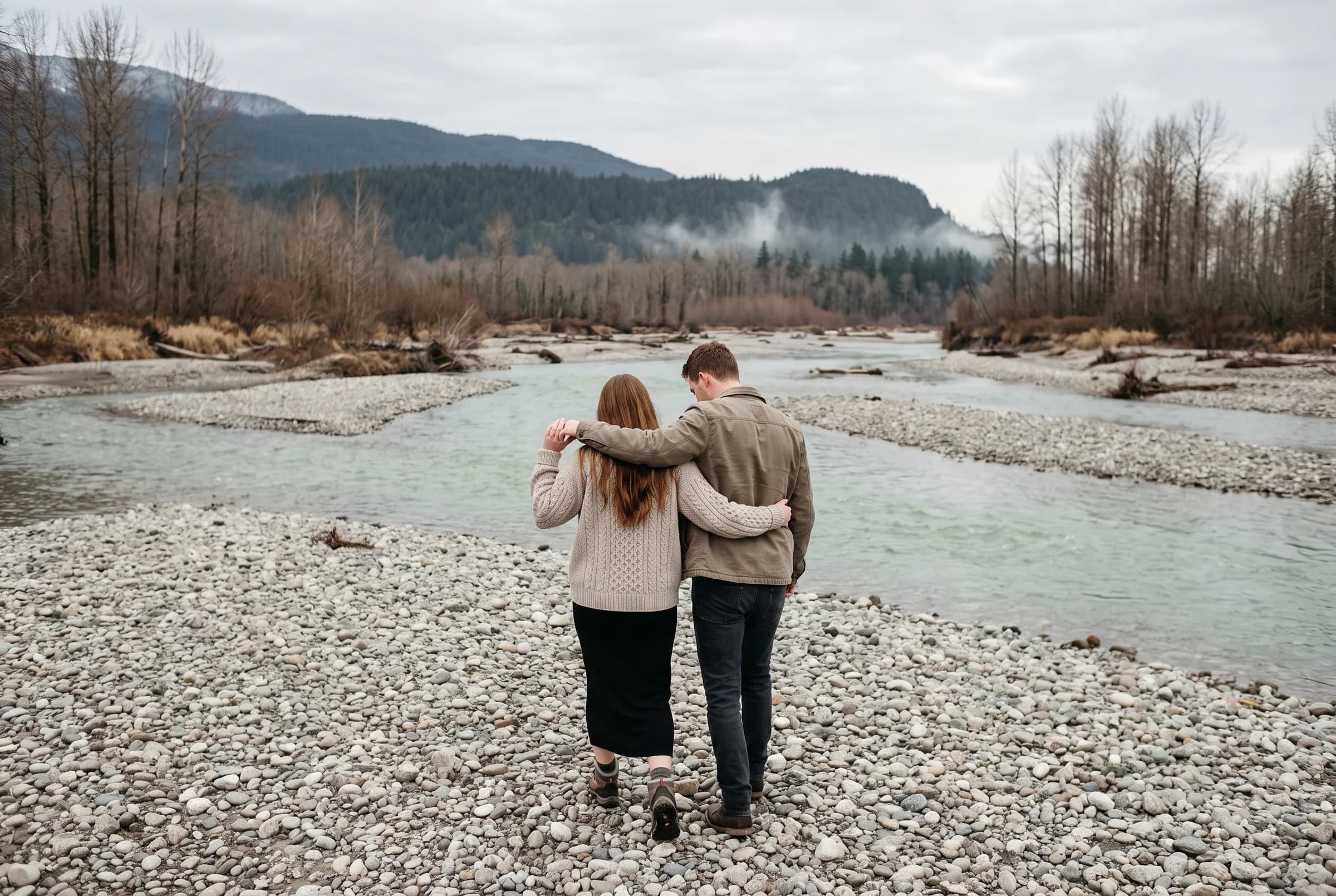
The Vedder in Chilliwack is a braided river running over wide pale gravel bars, with bare cottonwoods on the banks and low mountains close behind. The bars are big enough that you can walk right out into the middle of the river bed, which gives a sense of space that the forest locations cannot.
The real argument for it is emptiness. It is far enough east that you will mostly have it to yourselves, and on a session where you already feel self-conscious, having nobody walk through the back of the frame is worth more than most people expect.
Pacific Spirit Regional Park, for fog
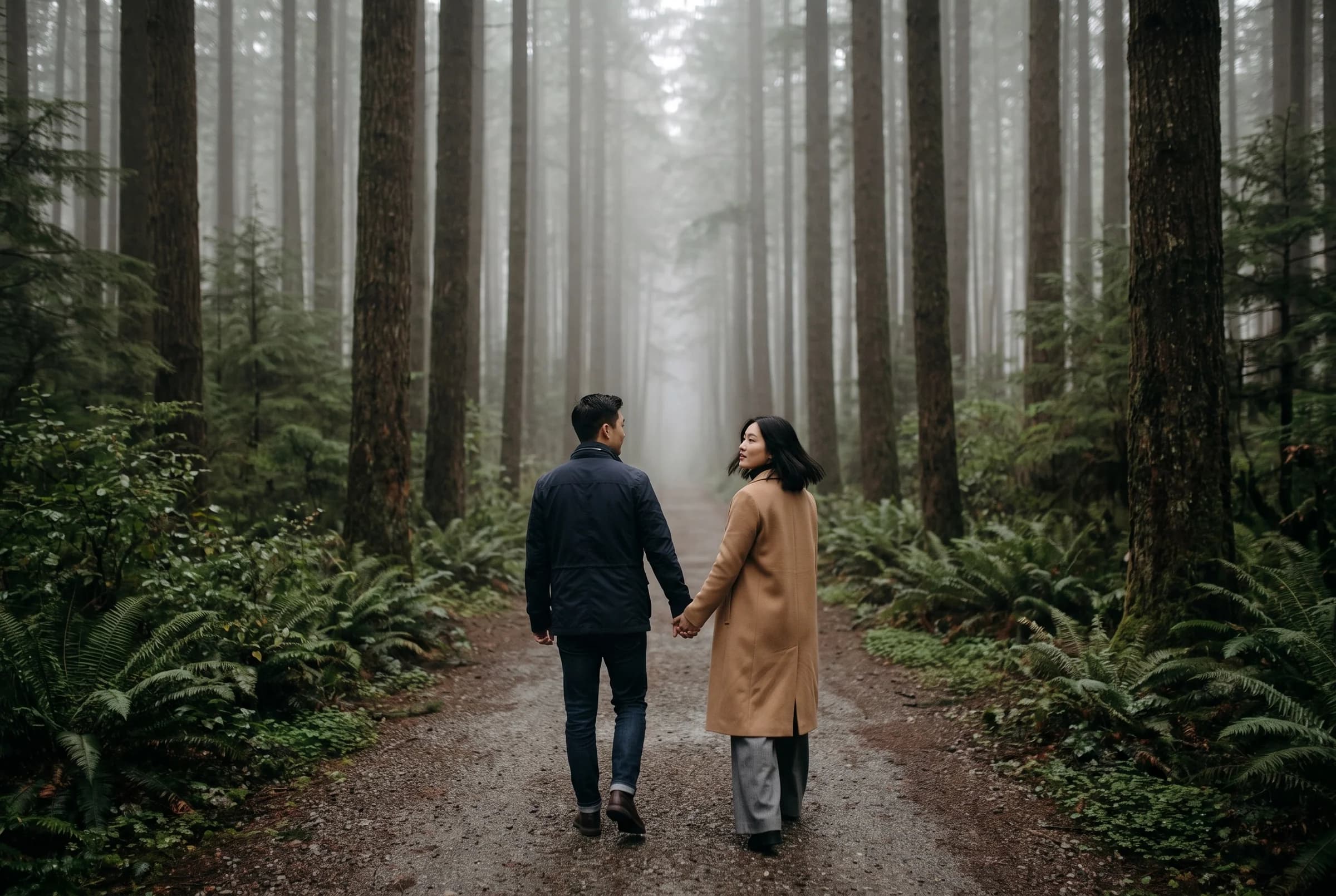
Pacific Spirit is a proper second-growth rainforest with nothing man-made in most directions, ten minutes from Kitsilano. Straight trunks, sword fern, wide soft trails that let you photograph down their length.
Go when it is foggy. A forest in flat light is a wall of green and a forest in direct sun is unrecoverable contrast, but fog separates the trunks into layers and turns the far end of a trail into nothing. It is the single best weather condition available in this city and it is free. Note that Metro Vancouver treats commercial photography in its regional parks as something that can require a permit, which is a conversation I have before your date rather than on it.
Campbell Valley Regional Park, for autumn colour
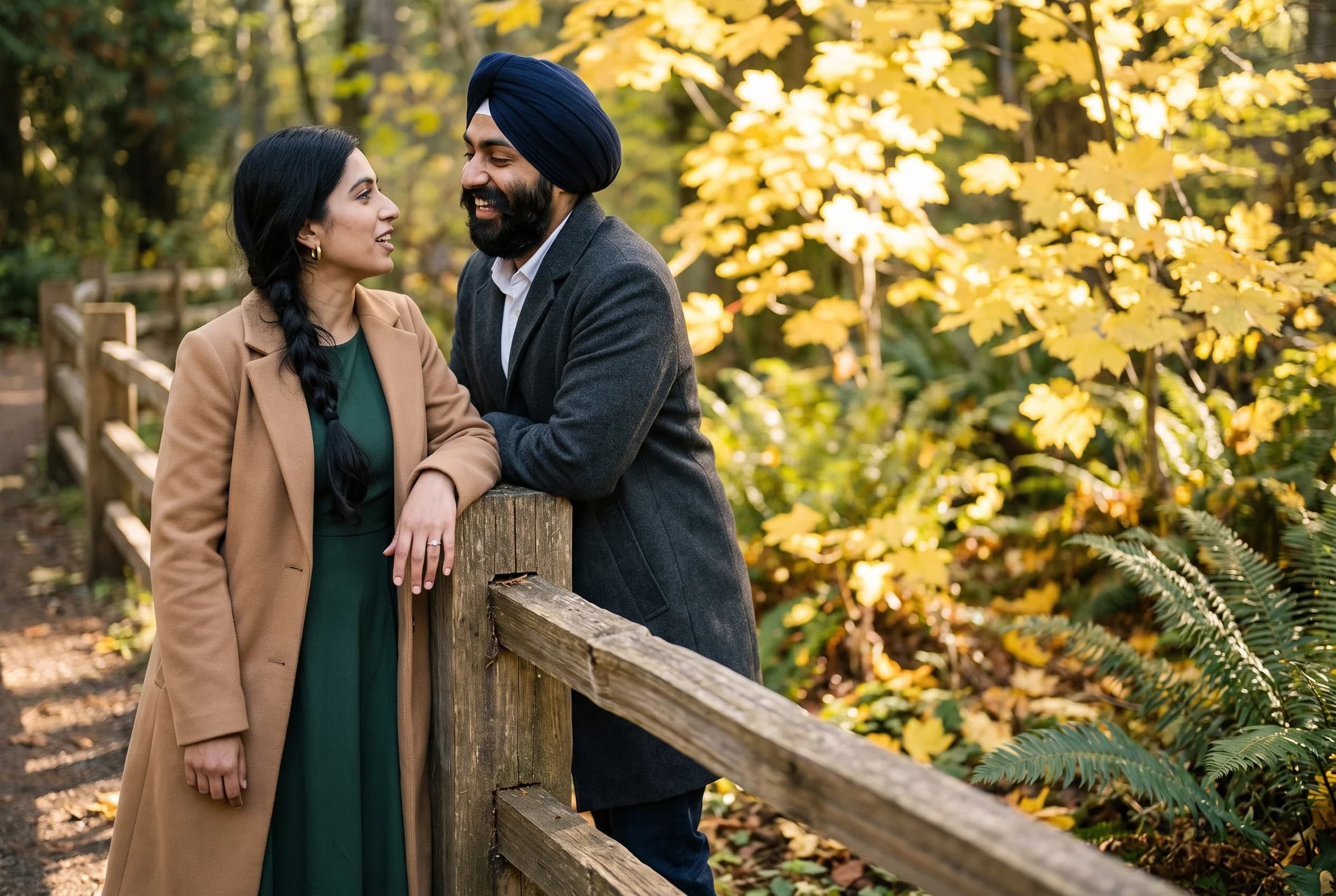
Campbell Valley in Langley is gentle lowland country: bigleaf maples that turn properly yellow, split-rail cedar fences, hayfield edges and quiet trails. It is the most pastoral location within reach of Vancouver and the least dramatic, which suits some couples exactly.
Its season is about three weeks long. Mid-October into early November is when the maples are worth the drive and the rest of the year it is a nice ordinary park. Metro Vancouver states plainly that commercial photography at Campbell Valley requires a permit, so this is one to organise in advance rather than turn up to.
Mount Seymour, for snow that is half an hour away
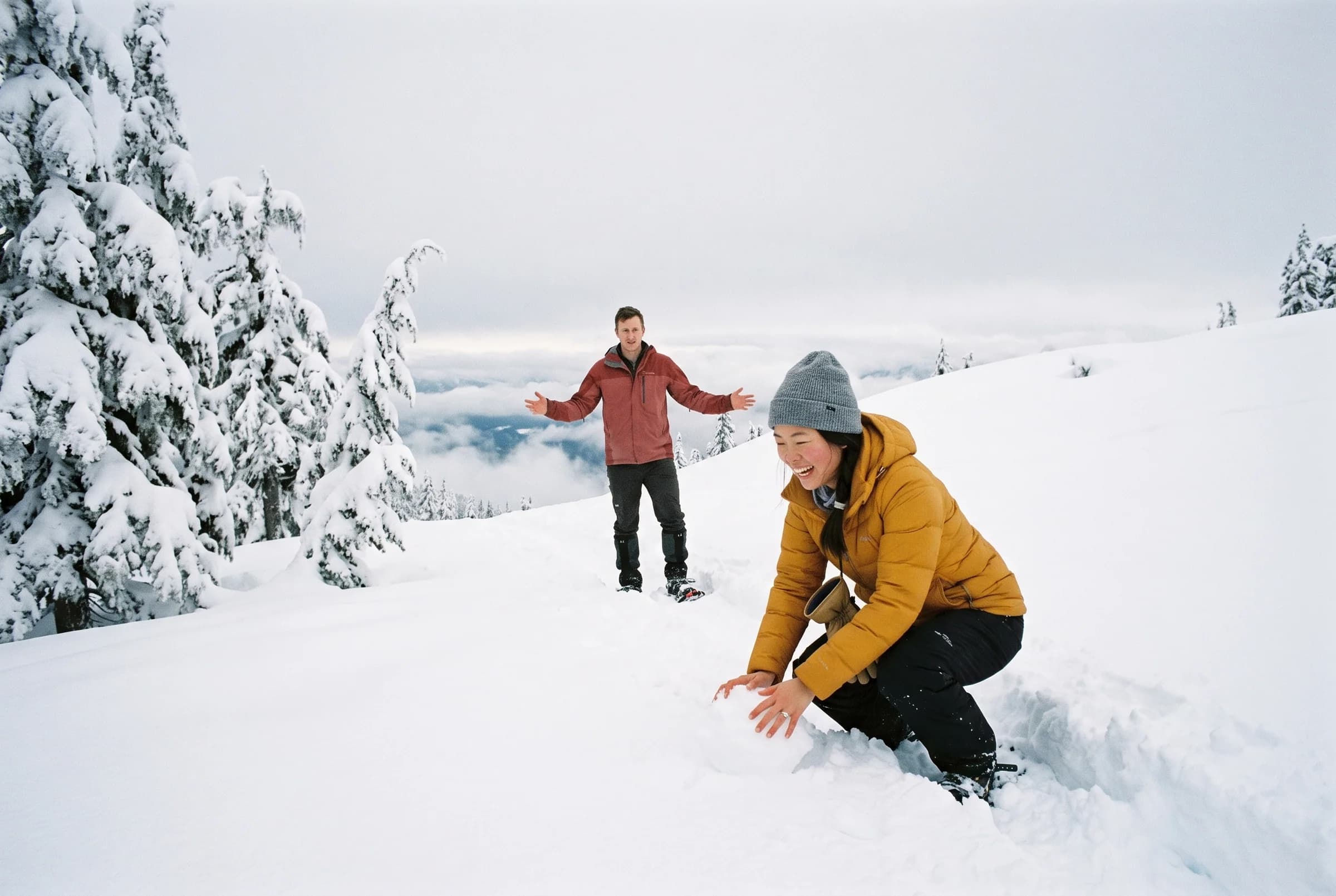
Seymour is the quietest of the three North Shore mountains and the one that feels most genuinely subalpine near the top. In winter the hemlocks get completely plastered and the snow is deep enough to play in, and unlike the other two you drive to it rather than buying a ticket.
Dress for it properly and plan for the pictures to be about the cold rather than in spite of it. The frames that work up here have people laughing at how cold they are. The ones that fail are the ones where somebody is trying to look serene in a coat that is not warm enough.
Grouse Mountain, for the city from above
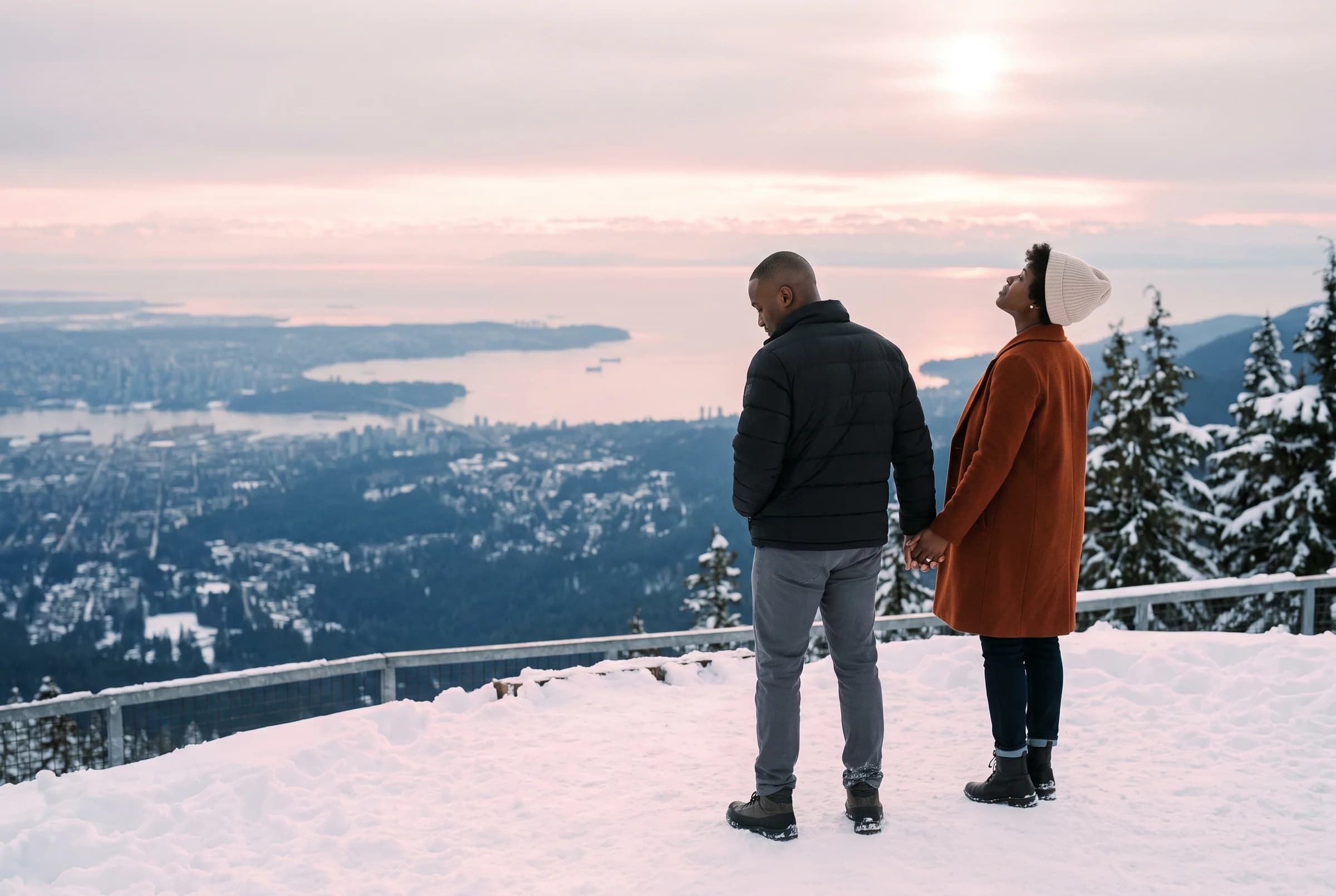
Grouse puts snow and the entire city in the same photograph, which no other accessible location here does. The view runs from the inlet across downtown to the Gulf Islands, and at the end of a winter afternoon the city goes blue while the sky over the water stays warm.
It is the only location on this list with an admission price. Reaching the top means the gondola, and the listed adult ticket is C$89 with a Lower Mainland rate of C$74, so budget for two before you decide. The alternative is Cypress, which is a drive rather than a ticket and gets you above the cloud on the right evening for nothing.
Downtown Vancouver, for a session that looks like a city
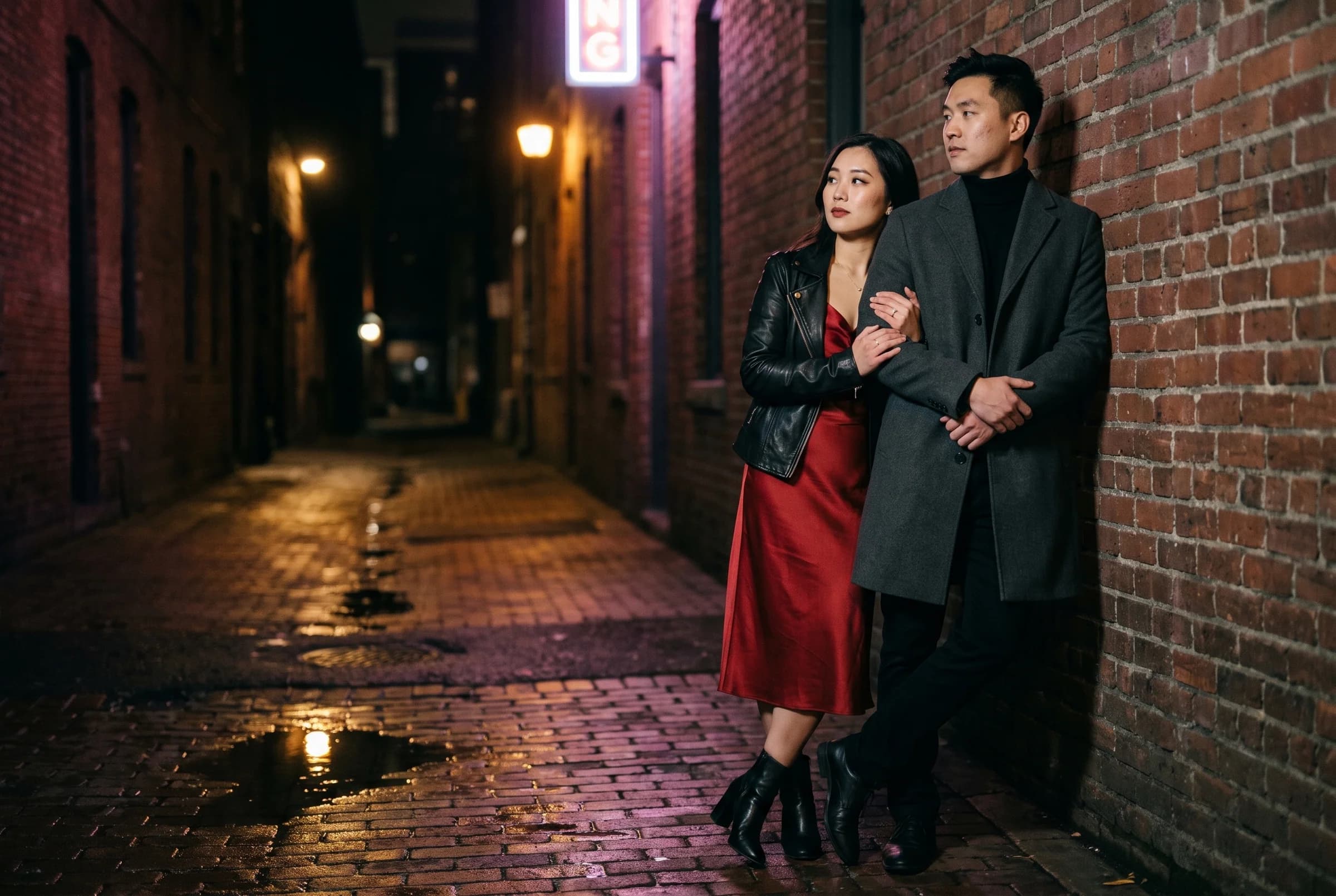
Vancouver has a real nineteenth and early twentieth century core around Gastown and the old financial district: stone cornices, painted brick, fire escapes and cobbles. It is the only location here that says city rather than coast, and for couples whose life together actually happens downtown it is the honest choice.
Shoot it at night, not in the afternoon. In daylight it is a nice old street. After dark, with wet cobbles and a mix of warm street lamps and neon, it becomes a genuinely different photograph, and rain helps rather than hurts. It is also the one location here that is completely immune to a bad forecast.
Lynn Canyon, for moss and green water
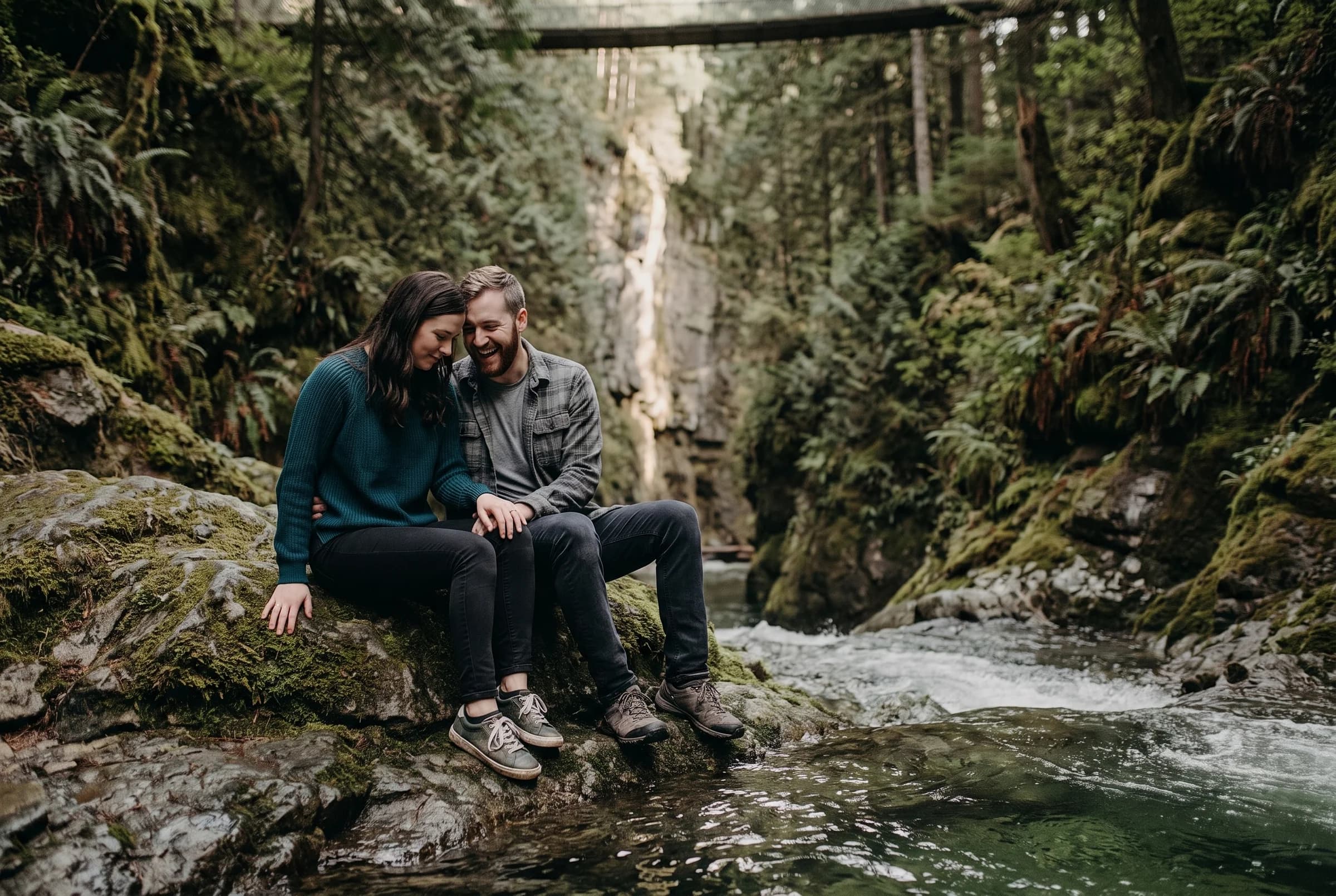
Everybody photographs the suspension bridge and the better frames are underneath it. Down on the canyon floor there are broad moss-covered boulders, clear green pools and enormous cedars, and the light is soft all day because very little of it gets in.
That low light is the constraint. It is dark down there, so this wants to happen with hours in hand rather than at the end of the day, and it wants shoes with grip because the rock is permanently wet. Go in spring when the water is running hard and the moss is at its most absurd.
Buntzen Lake, for stillness
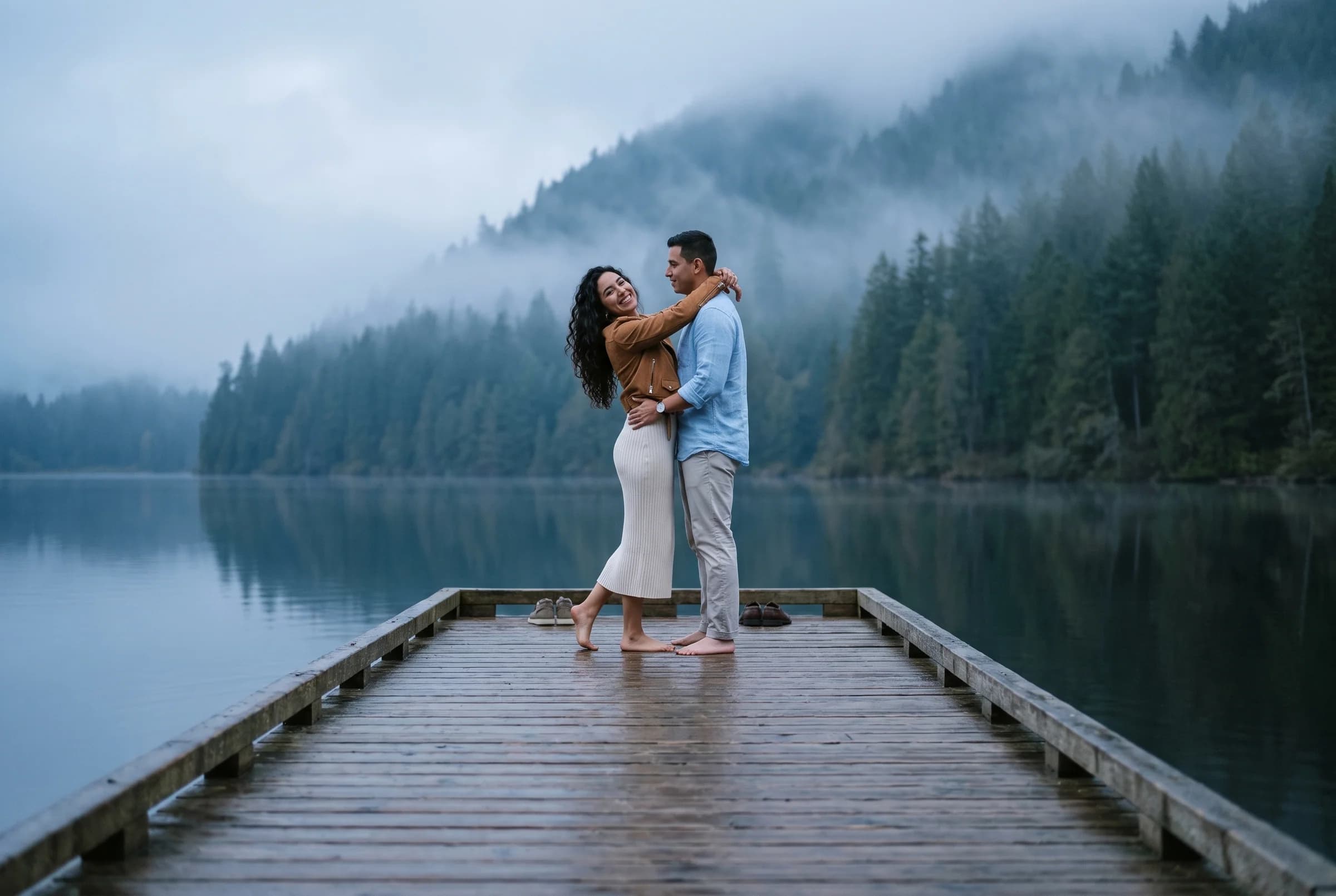
Buntzen is a narrow lake held between steep forested ridges, with a coarse beach and a floating dock that gives you a strong line to build a frame around. Early in the morning the water is completely still and the reflection is clean, and the mist tends to sit on it until the sun gets over the ridge.
Summer now needs a pass and a time slot. BC Hydro runs free but mandatory vehicle parking passes here from 14 May to 7 September, booked for a morning, afternoon or all-day block, and the gates open at 8am with a closing time that moves from about 4:30pm in winter to as late as 8pm in summer. Book the morning block and you get the still water as well as the parking space.
Stanley Park, for old growth ten minutes from a hotel
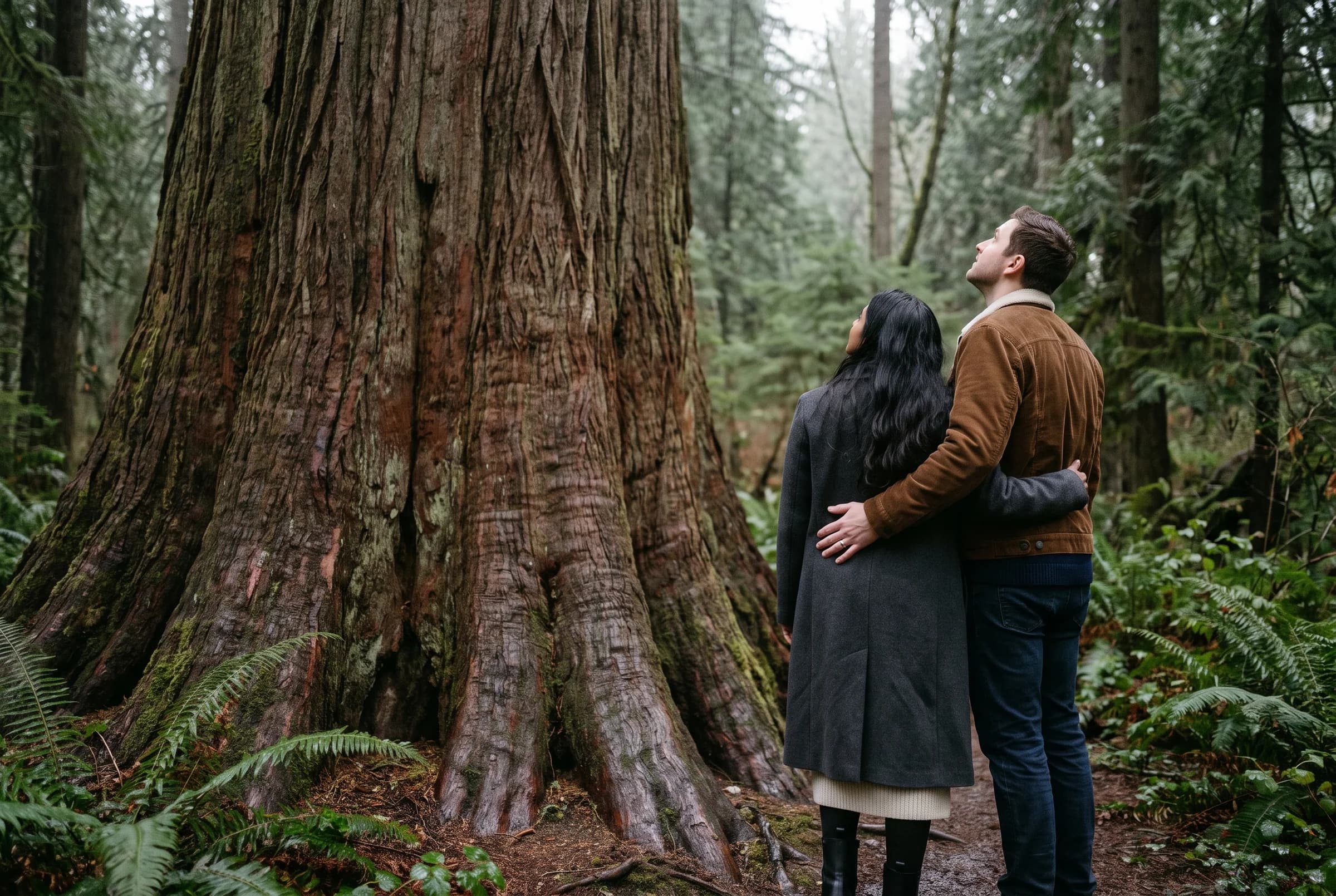
The interior trails of Stanley Park hold genuine old-growth cedar and fir with trunks wide enough that two people standing at the base read as very small, and it is ten minutes from a downtown hotel lobby. For out-of-town couples with one free afternoon, nothing else in Canada offers that trade.
The Vancouver Park Board does not require a permit to take wedding photographs in a city park, unless you bring setup with you, at which point it becomes a photography permit. A ceremony is a different matter and does need one. The rules are at vancouver.ca, and for an engagement session with two people and a camera you are fine.
VanDusen Botanical Garden, for the strongest reds in the city
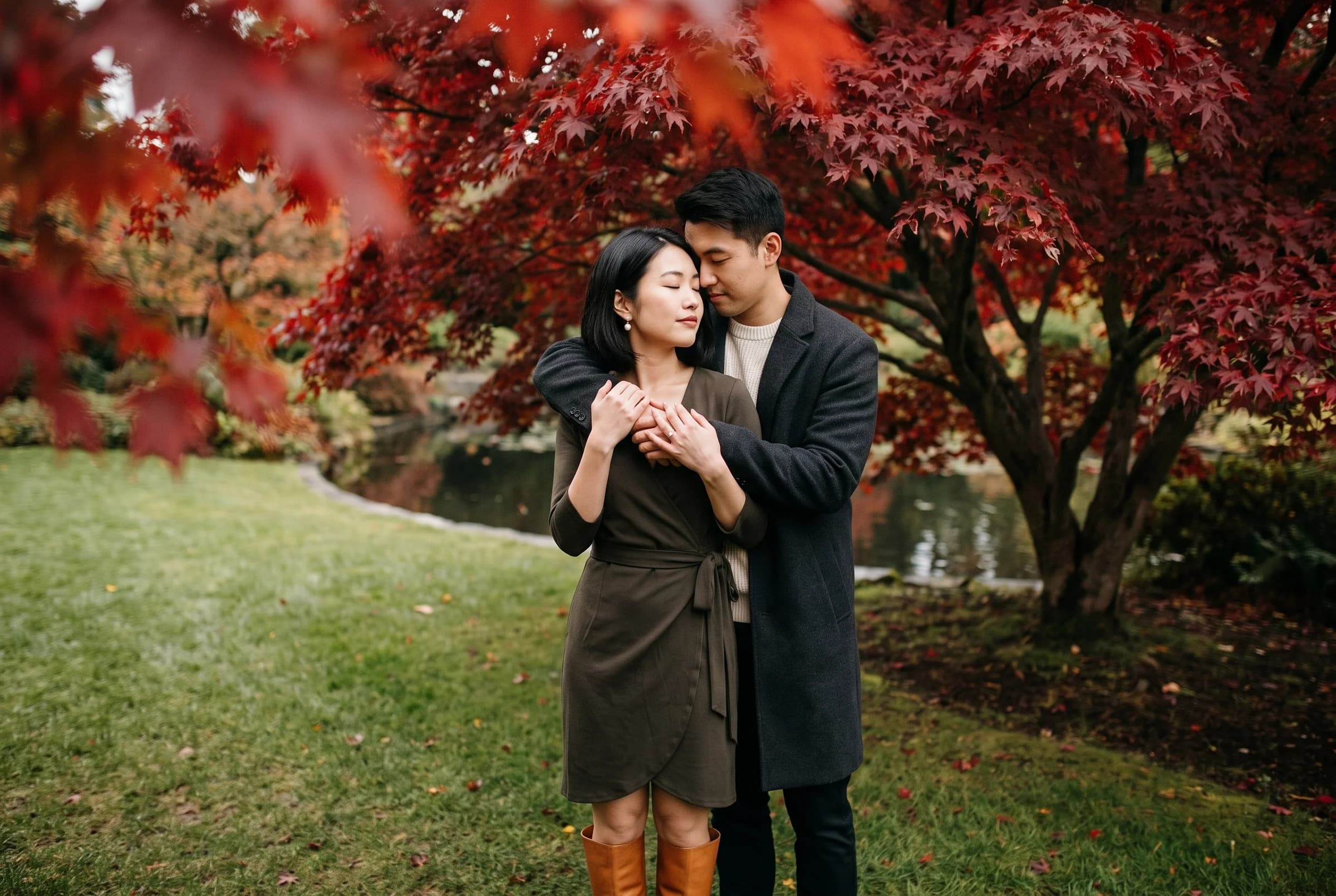
If you want the deep scarlet that people picture when they say autumn, you will not find it in a Vancouver forest. Our native bigleaf maple goes yellow and brown. The reds come from Japanese maples, which means a planted garden, and VanDusen has the best collection of them in the city, arranged around a pond that doubles every one of them.
VanDusen charges for a portrait session and the number is reasonable: C$111 for up to four people plus GST, with the photographer's admission included and no booking required. That is the cheapest paid access on this list and it buys a density of colour that would take an hour of driving to approximate. Note the closing time rather than the opening one, because through October the gates shut at 5pm and in November at 2pm, which removes the last hour of light from the plan entirely.
Nitobe Memorial Garden, for a composed frame in twenty minutes
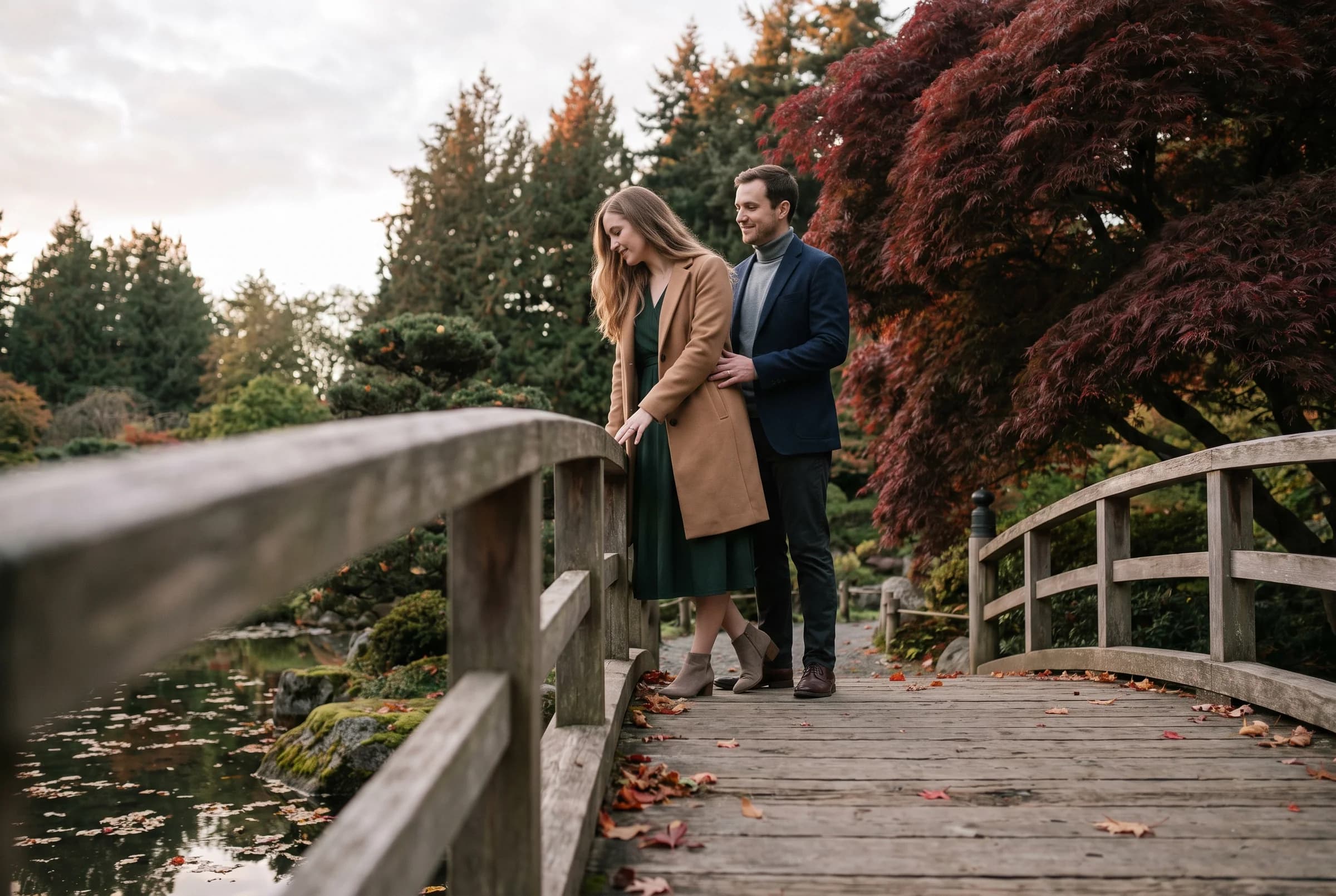
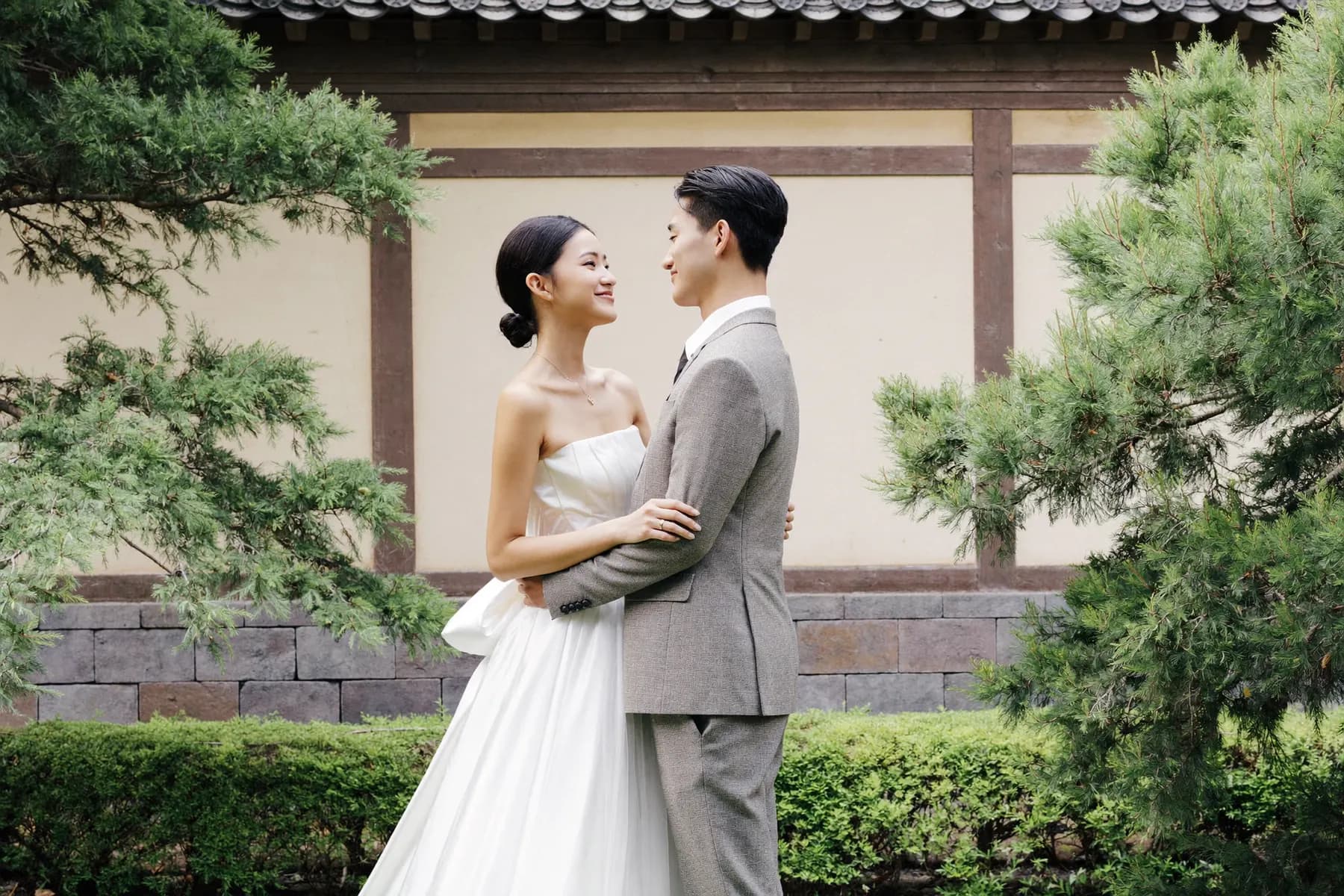
Nitobe is a formal Japanese stroll garden at UBC, small enough to walk in ten minutes and designed so that every turn of the path resolves into a deliberate view. The arched bridge, the stone lantern, the moss and the maples are all placed. Twenty minutes here produces more usable frames than an hour somewhere wild, because you are not hunting for a composition, you are choosing between ones that already exist.
UBC sells it as a booked session: C$300 for two hours covering up to fifteen people, and C$50 more to use the UBC Botanical Garden on the same day. The catch is the notice period. They want the request at least fifteen business days ahead, so this is a location you commit to in advance rather than one you switch to when the forecast turns. Through October it is open Tuesday to Sunday with last entry at 3:30pm.
Queen Elizabeth Park, for autumn without a fee
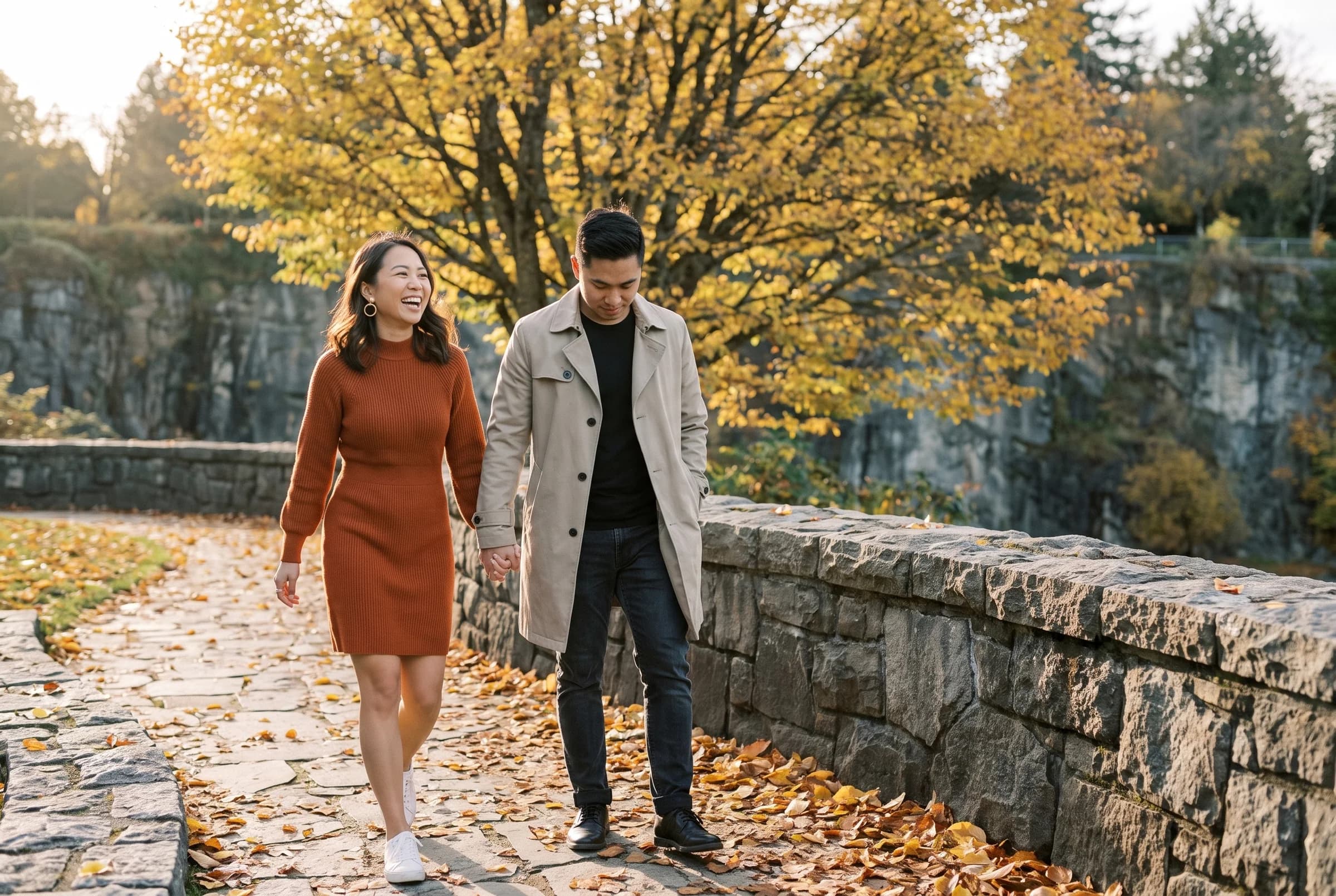
The Quarry Garden is a former stone quarry turned into a sunken garden, which means rock walls on three sides and a sheltered bowl that holds colour and blocks wind. Almost everyone photographs it from the rim looking down. The better frames are from inside it looking up, where the wall gives you a background that is neither sky nor foliage.
It is a Vancouver Park Board park, so an ordinary handheld session costs nothing and needs no permit. That combination, real autumn colour with no fee and no booking, makes it the best forecast-chasing location in the city. It is also the highest point in Vancouver, so the same trip gives you the skyline and the North Shore from the top without moving the car.
Derby Reach and Fort Langley, for river gold and a heritage street
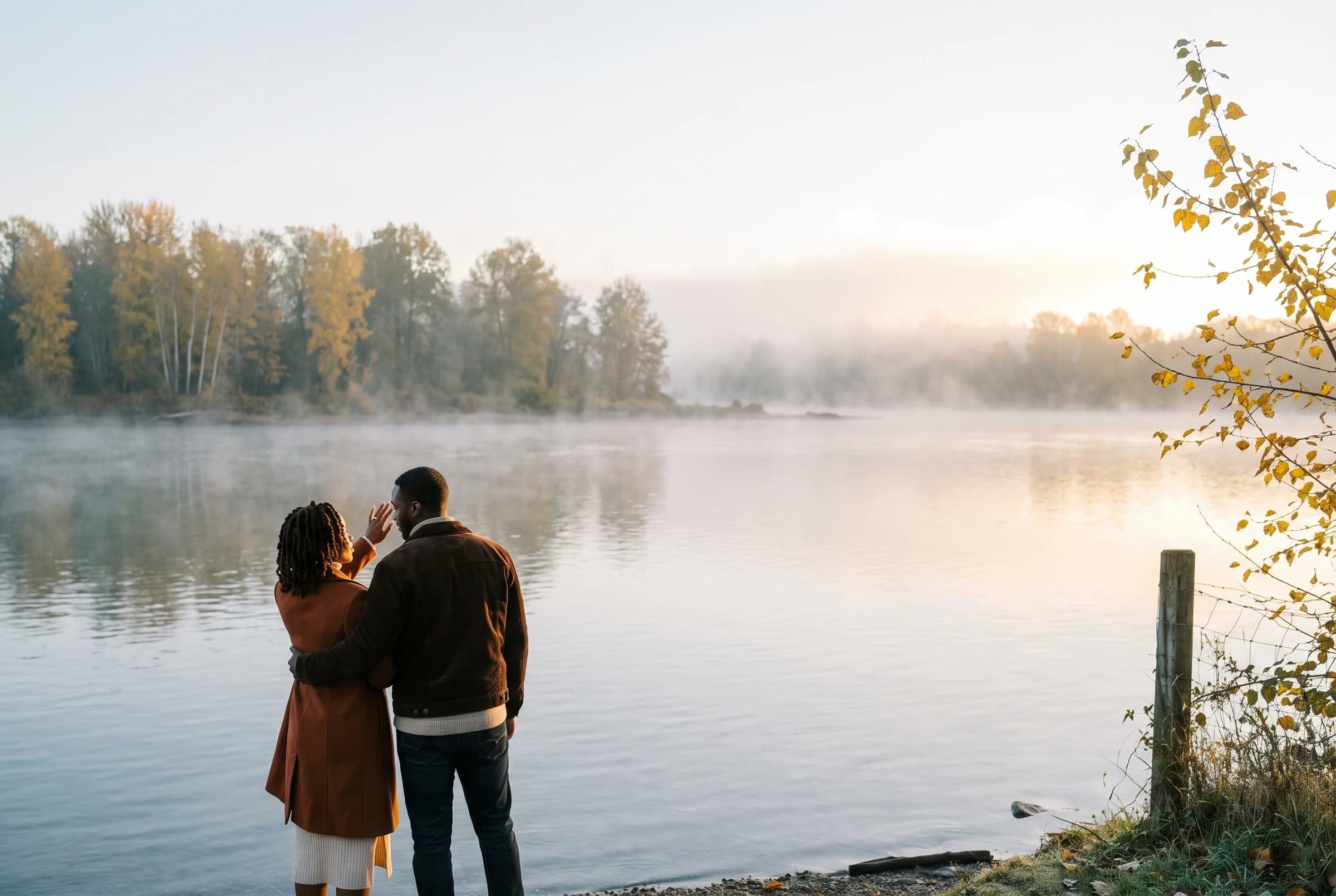
Derby Reach runs along the Fraser just outside Fort Langley, with a leaf-strewn riverside path, a weathered split-rail fence and tall cottonwoods and birches that turn a clean yellow. The river is wide and flat here, and on an October morning it holds mist until well after sunrise.
Pair it with the village and you get two completely different looks in one trip, riverbank gold and then heritage brick and clapboard five minutes away. Two warnings. Metro Vancouver's published photography permit names Campbell Valley and Aldergrove rather than Derby Reach, so I confirm the position for a paid session in writing beforehand. And the National Historic Site is a separate jurisdiction from the village around it: commercial photography inside the fort needs a Parks Canada permit, four weeks of notice and a refundable damage deposit, so we stay outside it unless you specifically want the fort.
Minnekhada Regional Park, for marsh and low cloud
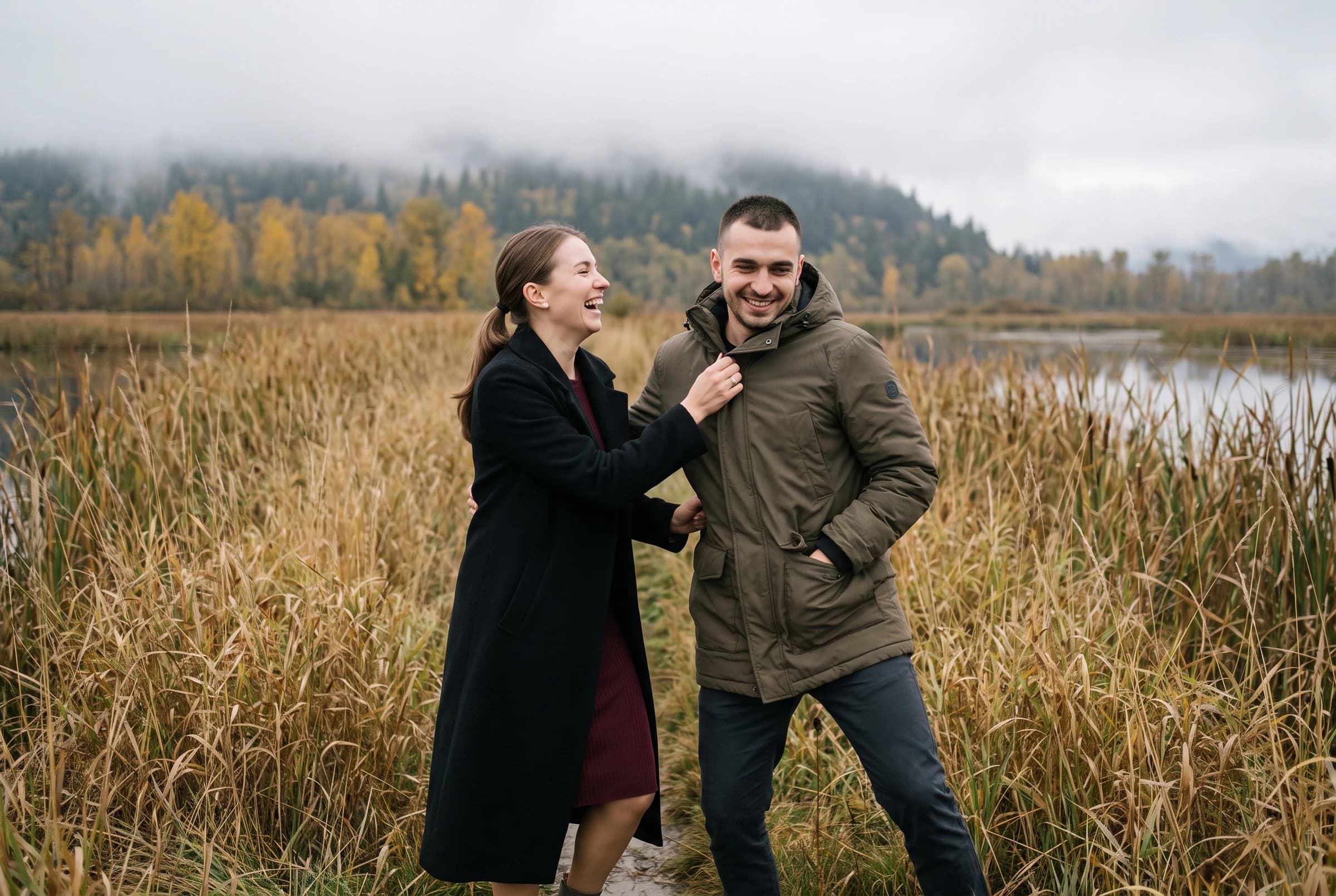
Minnekhada in Coquitlam is a large marsh ringed by a steep forested ridge, with dyke trails that take you out into the middle of it on level ground. The colour here is cottonwood and alder rather than maple, so it is gold and rust rather than red, and the real subject is the contrast between the open wet middle and the dark wall of forest around it.
It is at its best on exactly the day most people would cancel. Low cloud sitting halfway down the ridge, no sun, mist on the water. The gates matter more than the weather here though: they open at 7am and can close as early as 5pm, and the road toward the lodge is seasonally restricted, so we check the gate on the day rather than assuming.
The Callaghan Valley, for snow you can actually count on
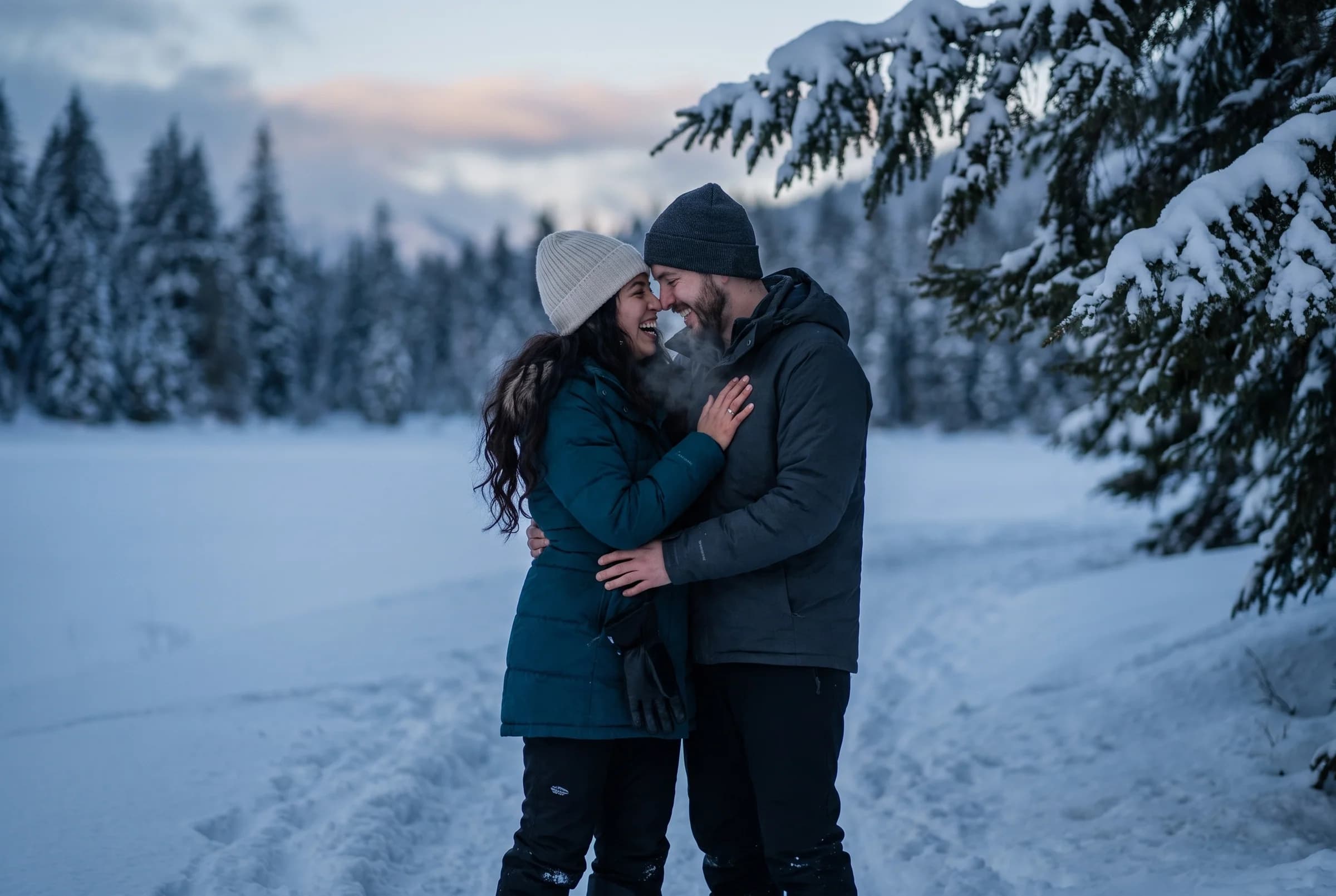
If the brief is a winter wonderland, this is the strongest answer near Vancouver. The Callaghan sits west of Whistler at roughly 840 to 930 metres, and the wider conservancy averages around 275 centimetres of snowpack, which is the difference between hoping for snow and booking it. You drive to the gate and walk the ticketed snowshoe network from there.
It is the one place on this list where a deep-snow photograph is a plan rather than a gamble. Two honest caveats. Whistler Olympic Park runs on its own winter schedule and the snowshoe admission is separate, so the date gets confirmed against their operating calendar before anything else. And the backcountry beyond the groomed network is a different proposition entirely, which is not where we go.
Cypress and Hollyburn, for snow-plastered trees half an hour from the city
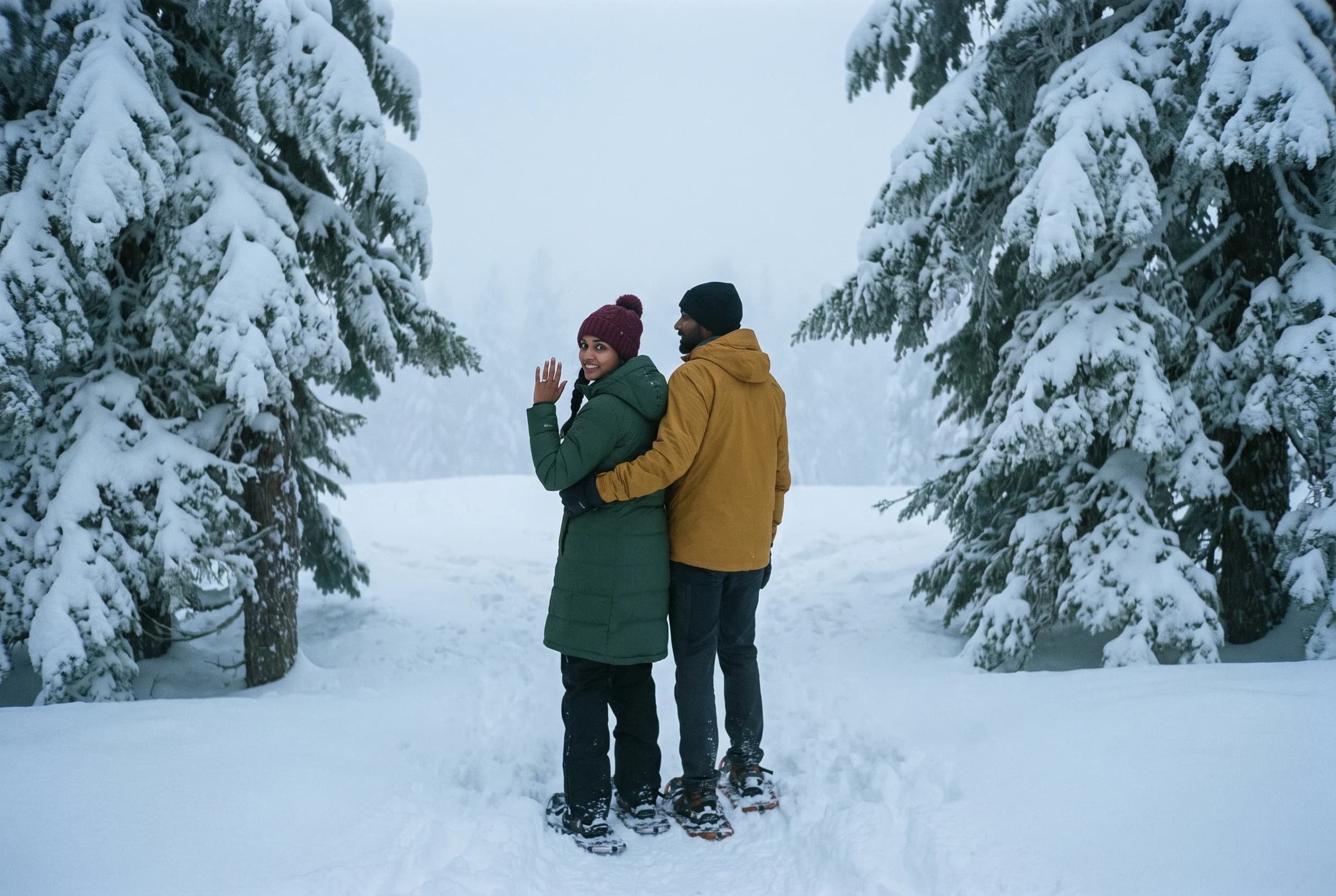
The nordic area at Cypress gives you the single most photogenic winter feature in the region, mountain hemlocks so completely plastered with wind-driven snow that they read as sculpted white forms rather than trees. Walking a snowshoe trail between two of them in fog is the closest thing to a guaranteed winter frame within forty minutes of downtown.
Two practical things decide whether this works. Winter tyres are required on Cypress Bowl Road from 1 October to 30 April and that is enforced, so the car matters as much as the coat. And the marked backcountry trails here, Hollyburn Peak included, travel through avalanche terrain according to BC Parks, so we stay on the inbound nordic network with a snowshoe ticket, which runs from about C$24. The photograph you want is on the groomed trail anyway.
Lightning Lake in Manning Park, for a frozen lake and a full day
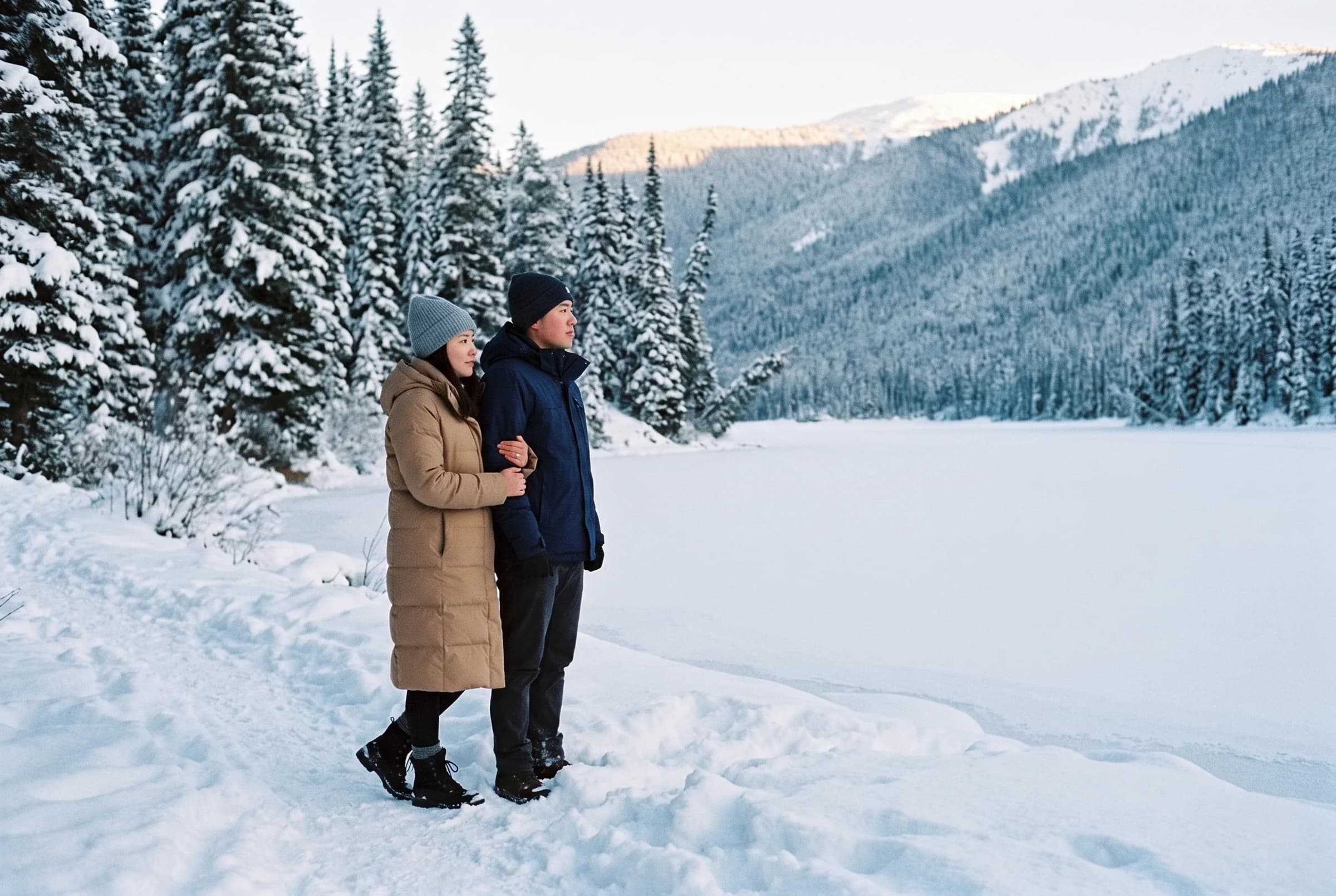
Lightning Lake sits at roughly 1,247 metres with a plowed day-use area and a shore trail, spruce and fir laden right down to the water line, and a long flat frozen surface running away between the ridges. It is the most complete winter landscape on this list and the one that least resembles anywhere near a city.
The cost is the day, not the money. Manning is around two and a half to three hours out in good conditions, and winter is not good conditions, so this is a full day rather than an afternoon. Highway 3 is a designated winter tyre route. We also stay on the shore: a lake that looks frozen is not evidence that it will hold two people, and I will not put you out on ice I have not seen assessed.
What the ground costs, park by park
A paid photographer is not treated the same way by every landowner, and the difference between two locations twenty minutes apart can be three hundred dollars. These are the published figures as they stand, and they are the reason I ask where before I ask when.
Two of those are worth acting on. The Metro Vancouver annual permit at C$200 covers both Campbell Valley and Aldergrove, which pays for itself on the third session of the year. And Whistler is administratively heavy for a one-hour shoot, which is why the Callaghan and Cypress get recommended ahead of it for winter.
These figures move. I check the current rule for your specific location in writing before your date rather than trusting a published page, this one included.
| Who owns it | What a session costs |
|---|---|
| Vancouver Park Board (Stanley, Queen Elizabeth) | Free, no permit, unless we bring setup |
| VanDusen Botanical Garden | C$111 for up to four people, plus GST |
| UBC gardens (Nitobe, Botanical) | C$300 for two hours, C$50 more for both |
| Burnaby (Deer Lake, Central Park) | C$286.80 simple, C$414.15 complex |
| Metro Vancouver (Campbell Valley, Aldergrove) | C$200 application, then C$75 a day or C$200 a year |
| BC Parks (Golden Ears, Alice Lake, Manning) | C$200 application plus C$100 for a minor shoot |
| Whistler municipal land | C$125 application, C$300 a day, plus licence and deposit |
| Sea to Sky Gondola | Pre-approval required, tickets plus an unpublished fee |
Booking one of these
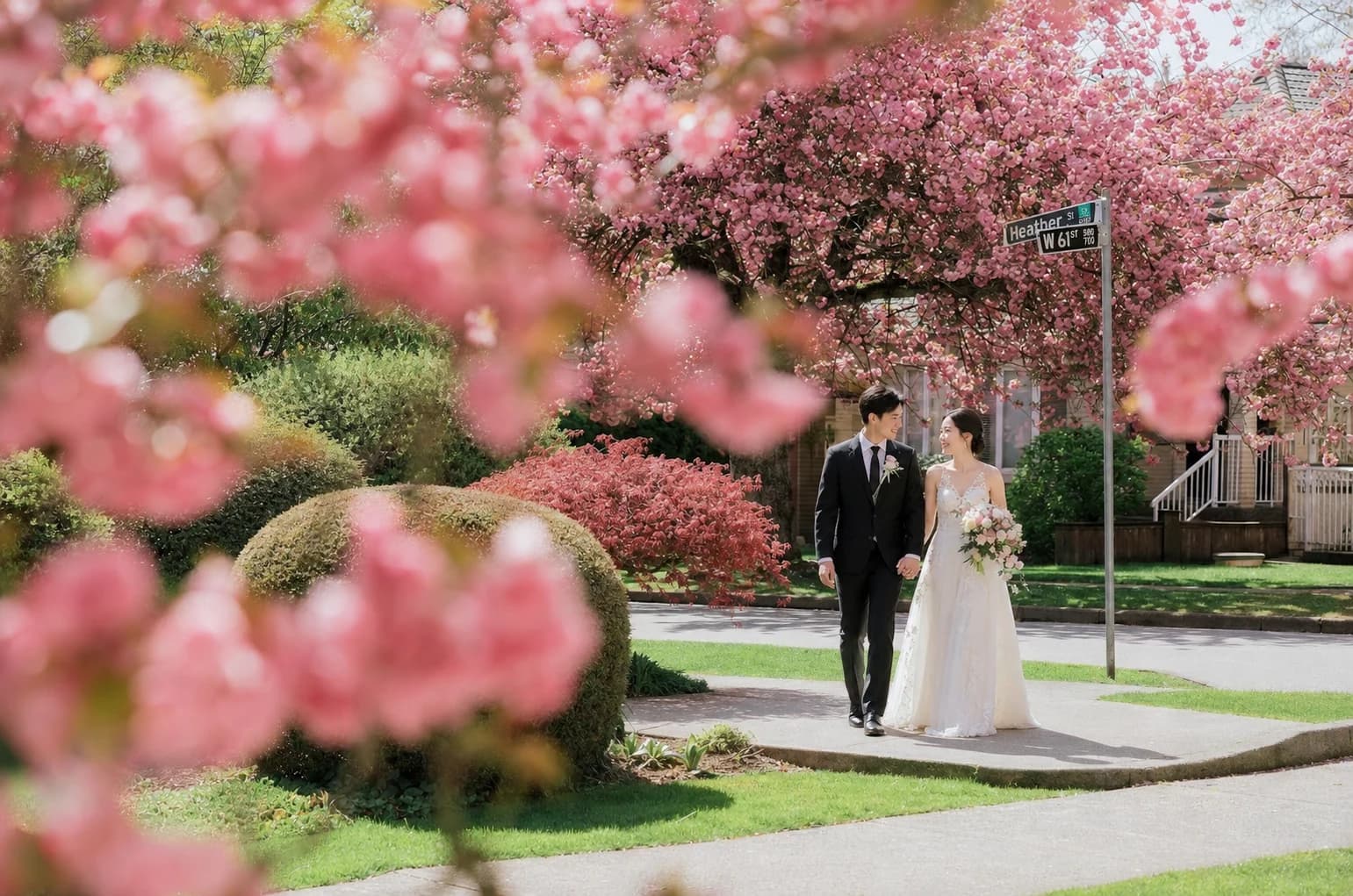
Book it six to nine months before the wedding rather than six weeks. That gives you the season you want rather than the season you are left with, and it means the photographs exist in time to be useful for a save-the-date. It also means the first time you are photographed together is not the morning of your wedding, which is the real reason the session is worth doing.
An engagement session is quoted alongside the wedding booking rather than sold off a shelf, because what it costs depends on which of these locations you choose and what the landowner charges a photographer to stand there. What the wedding day itself includes is set out on the experience page, and the city in detail sits on the Vancouver page.
Passes and permits change from year to year, so the current rule for your specific location gets confirmed in writing before the date rather than trusted to a journal entry, this one included. Send the month you are thinking of and you will get back the three that are actually worth your time in it.
Every wedding has different access, ceremony rules and travel time. A planning call turns the examples above into a timeline that belongs to your day.
